




Executive Summary
It used to be that the only way to get world-class financial leadership was to hire it full-time. A seasoned CFO, complete with years of operational scars and capital market experience, would sit at the head of the finance function and help a company grow, navigate capital events, manage risk, and speak to investors. That model made sense in a world where companies scaled linearly, where finance complexity matched headcount growth, and where hiring full-time was the default for every strategic role. But the world has changed. Growth is no longer linear. Markets are faster, capital cycles are shorter, and volatility is higher. Companies today scale in fits and starts. They go from seed to Series A with a few key hires. They reach profitability before reaching 100 employees. They move across borders with just a software subscription. Yet finance complexity has exploded. Between revenue recognition, international tax, equity compensation, fundraising strategy, burn rate forecasting, and internal controls, the needs of a startup often exceed what even a mid-sized company faced a decade ago. Throughout my twenty-five years leading finance across cybersecurity, SaaS, manufacturing, logistics, and gaming, I have learned that a new model of financial leadership is asserting itself, not as a lesser option but as the smarter one. Enter the fractional CFO.
The Fractional Advantage
A fractional CFO is not a bookkeeper dressed up with a better title. Nor is it a placeholder to keep investors happy. Done right, a fractional CFO is a high-caliber operator who brings Fortune 500 judgment to sub-500-person companies, precisely when they need it most and at a fraction of the cost. It is high-impact. It is low overhead. And it is becoming the preferred model for intelligent scale. At first glance, the idea might sound counterintuitive. How can someone who is only with you part-time deliver the strategic lift that a full-time CFO offers? The answer lies in leverage. A great fractional CFO does not sell time. They deliver clarity. They do not drown in month-end closes. They architect the systems that make the close clean. They do not replace your team. They elevate it.
When I improved month-end close from 17 days to under six days at a cybersecurity firm, the value was not in my daily presence but in designing systems that worked without constant oversight. When I implemented NetSuite and OpenAir PSA to automate revenue recognition and project accounting with 28 percent improvement in accuracy, the transformation came from architecture, not hours logged. That level of precision is exactly what modern companies need. Too many startups make the mistake of hiring a CFO before they need one full-time, paying $350,000 for a resource that spends half their day untangling spreadsheets or managing low-level vendor relationships. Others wait too long, only to find themselves caught flat-footed in a funding round or audit. The fractional CFO model solves both problems. It matches intensity with impact. You do not pay for hours. You pay for readiness.
Pattern Recognition and Force Multiplication
More than that, a good fractional CFO is a force multiplier. They come with pattern recognition. They have seen six business models fail and four succeed. They know what investor questions are coming before you have finished the pitch. They know where margins will compress. They understand when revenue needs to be reclassified. They know what your competitors’ board decks look like. And they have sat across the table from the auditors, the bankers, and the private equity partners. That experience does not just shorten learning curves. It reduces mistakes. And in finance, fewer mistakes mean more options.
When I led board reporting at a gaming enterprise where I oversaw $100 million in acquisitions and post-merger integration, I learned what investors scrutinize and what they gloss over. When I secured $40 million in Series B funding and an $8 million credit line at a nonprofit organization, I learned how to structure deals that provided flexibility rather than constraints. When I rebuilt GAAP and IFRS financials for a high-growth SaaS company and designed cohort analysis frameworks, I learned how to translate operational metrics into financial narratives that investors understand. This accumulated knowledge becomes exponentially valuable when deployed fractionally across multiple companies.
The magic of the model lies not just in what it avoids but in what it enables. When a company brings in a fractional CFO, they gain not only technical acumen but a decision partner. Someone who can help a founder think about second and third-order effects. Someone who knows how to read the behavior of a boardroom. Someone who has the credibility to talk to a Series B investor while still being able to dive into a deferred revenue schedule. That duality, the strategic paired with the operational, is rare. The fractional model, by design, attracts exactly that profile.
There is a humility to great fractional CFOs. They do not need the corner office. They do not care about politics. They want to solve problems. They are often ex-CFOs of larger firms, now choosing to work across multiple companies because they enjoy the diversity, the pace, and the challenge. That shift is not just a lifestyle choice. It is a market signal. The best financial talent is moving to fractional work not because they cannot go full-time but because they do not need to.
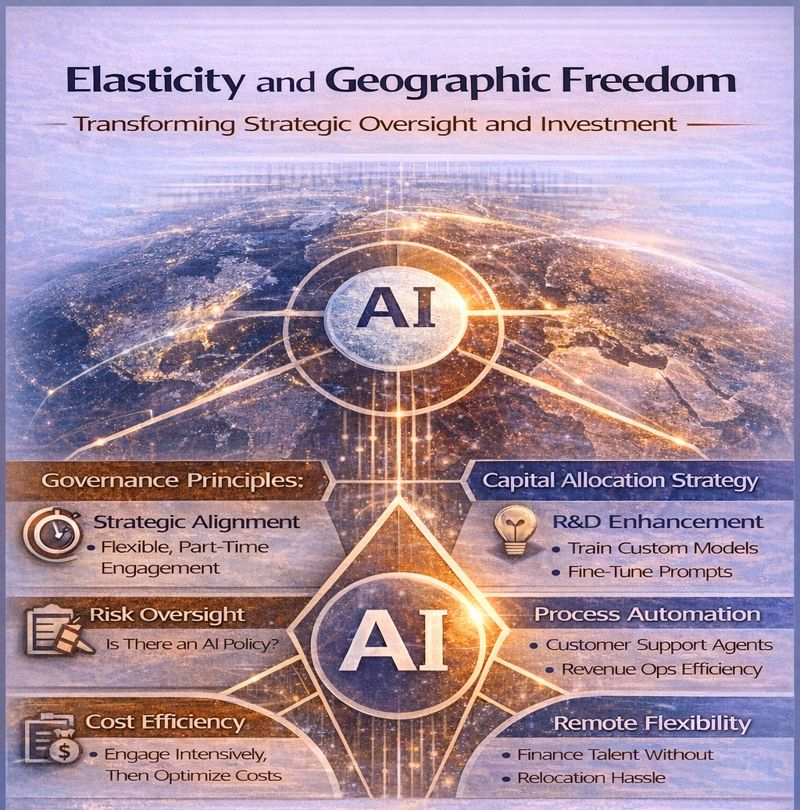
Elasticity and Geographic Freedom
And that presents an opportunity for companies who know how to harness it. A fractional CFO can lead your financial strategy through a fundraise, then fade into the background as a part-time resource. They can build your board reporting frameworks, train your controller, and set up your financial model, and then hand it off. They can engage more deeply during strategic initiatives, then disengage to reduce cost. This elasticity is powerful. It lets companies pay for leadership when it matters and avoid carrying it when it does not.
When I designed multi-entity global finance architecture spanning the United States, India, and Nepal, the work required intense focus during design and implementation but minimal ongoing involvement once systems were operational. When I managed global finance for a $120 million logistics organization and overhauled freight, warehouse management, and last-mile logistics processes to reduce logistics cost per unit by 22 percent, the transformation required concentrated expertise followed by handoff to operations. This pattern of high-intensity engagement followed by strategic oversight is exactly what fractional models enable.
Critically, this model also changes the talent equation for startups outside major hubs. In the past, a company in Kansas City or Boise might struggle to attract a tier-one CFO. Now, with fractional models and remote work, they can get access to Silicon Valley-grade talent without the cost or the relocation. Geography is no longer destiny. Capability is portable. And finance leadership can be scaled as a service, not as a permanent headcount line item.
Investor Perspective and Transition Management
Investors are noticing. Savvy venture firms increasingly recommend fractional CFOs to their portfolio companies. Not because they want to cut corners, but because they know the damage a premature or ill-fit CFO hire can do. A bad CFO does not just fumble compliance. They distort decision-making. They build the wrong dashboards. They communicate poorly with the board. They drain founders of focus. A fractional model lets investors install a trusted partner quickly, stabilize the company, and buy time to find the right full-time hire if it is needed at all.
This model is especially valuable in transitions. Whether it is a pivot in the business model, a sudden capital raise, a departure of the head of finance, or a pre-IPO sprint, these are moments when finance complexity spikes but continuity is fragile. A fractional CFO steps in, creates signal from noise, and restores the company’s ability to make decisions. They bring method to the madness and act as a bridge between chaos and control. When I reduced monthly burn from $800,000 to $200,000 at an email marketing SaaS company, the engagement was transitional. The company needed immediate clarity on runway, cost structure, and path to profitability. I provided that clarity, implemented sustainable financial discipline, and handed off to internal leadership.
There is also strategic benefit to the fractional approach in succession planning. Many companies find themselves with long-tenured controllers or finance managers who know the systems but lack strategic range. A fractional CFO can elevate these team members, mentoring them while filling the strategic gap. Over time, the internal team levels up. The company gets stronger. And the finance function becomes more than just a cost center. It becomes a competitive edge. When I built enterprise KPI frameworks using MicroStrategy, Domo, and Power BI tracking bookings, utilization, backlog, annual recurring revenue, pipeline health, customer margin, and retention, I trained internal teams on interpretation and action, not just data collection.
The Value Proposition
For founders, the value proposition is clear. You want to build, not babysit finance. You want visibility, not volume. You want confidence that your runway is real, your metrics are clean, and your fundraising story will survive due diligence. A fractional CFO gives you that confidence. They speak your language. They have sat in your seat. And they bring the calm of someone who has seen the movie before. At a digital marketing company where we scaled revenue from $9 million to $180 million, the founders needed financial leadership that could grow with the business without constraining agility. Fractional engagement during critical growth phases provided strategic guidance while preserving operational flexibility.
From a board’s perspective, the model reduces governance risk. It gives directors the comfort that financial oversight is in place, even if the company is small. It shows seriousness without bloat. And it enables boards to focus on strategic contribution rather than basic oversight. That alignment of interests between leadership, finance, and governance is one of the unsung advantages of the fractional approach. My certifications as a CPA, CMA, and CIA provide boards with confidence that governance, controls, and risk management are being handled by someone with deep technical credentials and practical experience.
We are entering a period where capital is no longer free. Valuations are being tested. Unit economics matter again. And scrutiny, both internal and external, is rising. In this environment, financial discipline is not optional. It is existential. But discipline does not require a bloated general and administrative expense base. It requires judgment. And judgment can be bought by the hour if you know where to look.
Conclusion
The fractional CFO is not a trend. It is a response to reality. A reality where agility matters more than hierarchy. Where clarity is more valuable than complexity. Where talent moves faster than organizational charts. And where companies need to be financially fluent long before they are financially mature. So if you are building, scaling, or simply trying to make smarter decisions under pressure, ask yourself not whether you can afford a fractional CFO but whether you can afford not to. Because in a world of constrained capital and rising expectations, high-impact and low overhead is no longer a luxury. It is the model of the future.
Disclaimer: This blog is intended for informational purposes only and does not constitute legal, tax, or accounting advice. You should consult your own tax advisor or counsel for advice tailored to your specific situation.
Hindol Datta is a seasoned finance executive with over 25 years of leadership experience across SaaS, cybersecurity, logistics, and digital marketing industries. He has served as CFO and VP of Finance in both public and private companies, leading $120M+ in fundraising and $150M+ in M&A transactions while driving predictive analytics and ERP transformations. Known for blending strategic foresight with operational discipline, he builds high-performing global finance organizations that enable scalable growth and data-driven decision-making.
AI-assisted insights, supplemented by 25 years of finance leadership experience.