
Executive Summary
In an era of structural uncertainty and relentless change, the most valuable quality in financial leadership is not technical mastery alone but clarity of thought. First principles thinking, the practice of breaking down problems to their most fundamental truths and rebuilding solutions from the ground up, has become a strategic necessity for modern CFOs. Our role has evolved beyond reporting results to defining value creation levers, clarifying cross-functional trade-offs, and enabling capital deployment with conviction. This cannot be accomplished through adherence to precedent, industry heuristics, or surface-level metrics. First principles reasoning strips away conventional assumptions, isolates what is fundamentally true, and constructs decisions based on causal logic rather than analogy. Throughout my twenty-five years leading finance across cybersecurity, SaaS, manufacturing, logistics, and gaming, I have witnessed how this mode of thinking transforms not just financial outcomes but organizational culture. When CFOs demonstrate rigorous inquiry rooted in first principles, decision quality rises across the enterprise. Scarcity becomes a design constraint rather than a limitation. Every dollar becomes a hypothesis tested against reality. This approach empowers finance leaders to move from validating plans to creating clarity, from controlling costs to architecting systems, and from interpreting lagging indicators to operating strategically with foresight.
The Foundation of First Principles Reasoning
First principles thinking begins by ignoring precedent and identifying the atomic elements of a challenge. Consider the pressure to cut costs, a scenario every CFO faces. The conventional approach benchmarks against peers, freezes hiring, or renegotiates vendor contracts. The first principles CFO starts differently, asking what is the actual unit of value creation in this company, what are the fixed and variable components of value delivery, and where is the entropy where money or time gets wasted with no compounding return.
This leads to more fundamental action. Perhaps the bottleneck is not spending but poor product-market alignment. Perhaps the issue is not too many people but unclear decision rights that cause friction and delay. Benchmarking might help you look average. First principles help you become excellent.
Throughout my career, from reducing monthly burn from $800,000 to $200,000 at an email marketing SaaS company to improving month-end close from 17 days to under six days at a cybersecurity firm, the breakthroughs came not from following industry standards but from questioning what was truly necessary. When we designed multi-entity global finance architecture spanning the United States, India, and Nepal, we did not replicate what other companies had done. We mapped the fundamental flows of data, authority, and accountability that our specific operating model required. The result was a finance function that served the business rather than constraining it.
Separating Fundamentals from Convention
Capital planning decisions reveal the power of separating fundamentals from convention. When a company considers entering a new market, the conventional approach assesses total addressable market, compares customer acquisition cost to lifetime value, and estimates break-even timelines. But what if the market has network effects that skew adoption? What if the product does not meet local compliance or user experience expectations? What if talent supply is constrained in that geography?
The first principles CFO breaks the problem down differently, asking what must be true for this expansion to succeed, what assumptions are we making based on past market entries that may not hold here, and what is the irreducible complexity of launching in this region. Instead of forcing a model to work, this reasoning guides deeper diligence, smarter phasing, and better capital protection.
When I led global finance and supply chain analytics for a $120 million logistics and wholesale organization, we faced decisions about geographic expansion and channel strategy. Rather than extrapolating from past performance, we modeled the fundamental economics of freight, warehousing, and last-mile delivery in each target market. We discovered that what appeared to be a high-margin opportunity would have been destroyed by logistics constraints we had not faced in our existing markets. The discipline of first principles reasoning saved the company from a costly mistake disguised as growth.
Rebuilding from the Ground Up
First principles reasoning does not stop at deconstruction. It rebuilds based on fundamentals. When redesigning an operating plan, rather than rolling forward last year’s plan with inflation adjustments, start fresh. Ask what the customer truly values and pays for, what are the minimum capabilities needed to deliver that value at scale, and what systems and teams reinforce that value versus those that do not.
From this, you may conclude that some business units, while profitable, do not reinforce strategic differentiation. Others may operate at a loss today but build optionality for the future. First principles CFOs build a business portfolio based on value coherence, not just profit and loss contribution.
At a digital marketing company where we scaled revenue from $9 million to $180 million, we regularly questioned whether each function was truly necessary for value creation. We discovered that certain reporting processes consumed significant resources but created no decision value. We also found that investments in client-facing analytics capabilities, though initially unprofitable, created compounding returns through customer retention and expansion. By continually applying first principles reasoning to resource allocation, we focused capital on what truly mattered.
Translating Complexity into Clarity
One of the CFO’s superpowers lies in narrative synthesis. Markets, boards, and internal teams crave clarity, especially in complexity. First principles give you the vocabulary to describe decisions not in accounting terms but in causal logic. Instead of saying we are increasing selling, general, and administrative expenses by 12 percent due to expansion plans, say to double revenue, we must open two new segments, cut onboarding time by half, and support a 50 percent increase in customer volume, and this increase in expenses funds those three requirements directly.
By anchoring decisions in cause and effect logic, you become not just a reporter of financials but the interpreter of value intent. When I implemented NetSuite and OpenAir PSA systems to automate revenue recognition and project accounting, the conversation with the board was not about technology spend. It was about eliminating the bottleneck that prevented us from scaling professional services revenue while maintaining margin discipline. The 28 percent improvement in accuracy was a byproduct of addressing the fundamental constraint.
Leading Cultural Transformation Through Reasoning
Leading from the front means creating a culture where reason outpaces routine. First principles CFOs do not just run finance. They upgrade the thinking of the entire company. This means asking teams what assumption are we making here, encouraging product and go-to-market functions to quantify feedback loops, coaching teams to articulate not just what they are doing but why from first logic, and removing legacy metrics that confuse activity with progress.
When the CFO demonstrates this level of inquiry and logic, it permeates the company. Decision quality rises. Scarcity is embraced as a design constraint. Every dollar becomes a hypothesis tested against reality. At a nonprofit where I served as CFO and secured $40 million in Series B funding, we instituted a practice of requiring every budget request to articulate the fundamental assumption that made the investment necessary. This simple discipline eliminated wasteful spending and redirected capital to initiatives with clear causal links to mission impact.
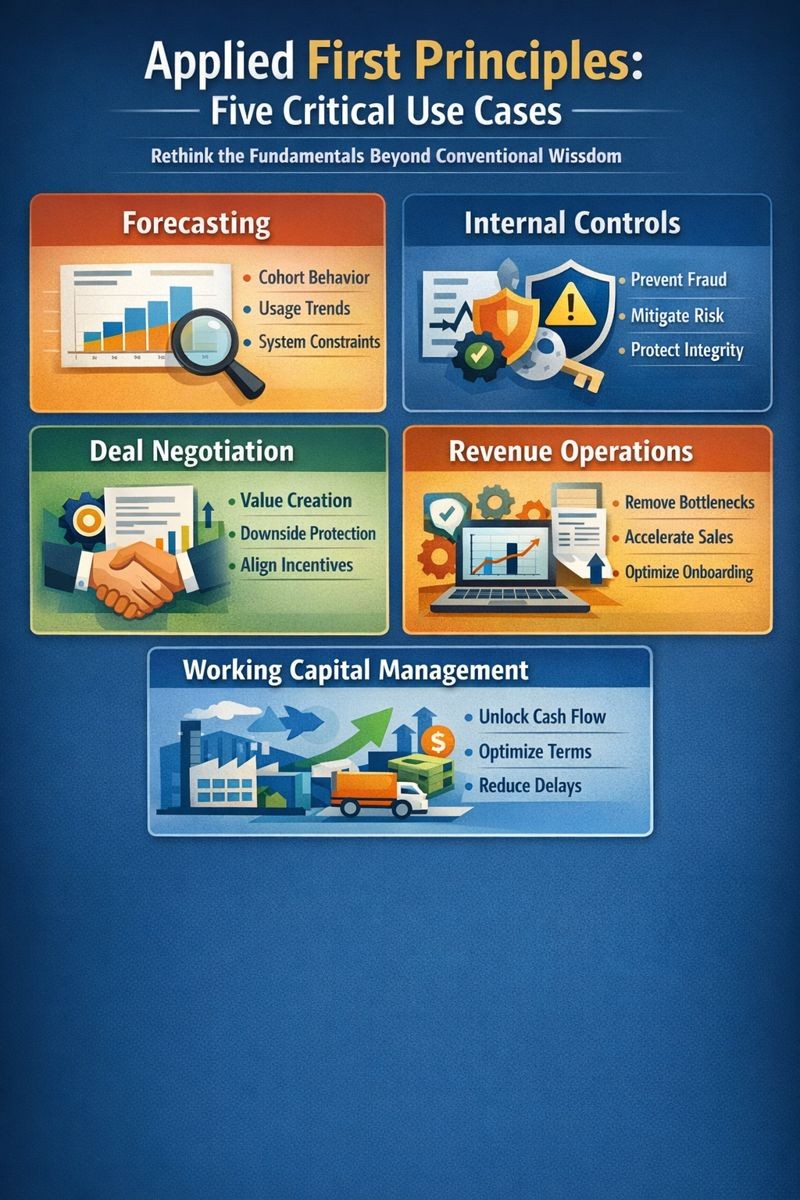
Applied First Principles: Five Critical Use Cases
1. Forecasting
Most forecasting is built by rolling forward historical trends with minor adjustments. It is essentially curve fitting past behavior under the guise of planning. First principles reframe this by asking what are the elemental drivers of revenue, cost, and cash flow. Instead of asking what did we do last quarter, ask what are the primary units of economic activity in our business, what signals correlate with forward revenue, and what system constraints will prevent current run rate from compounding.
When I rebuilt GAAP and IFRS financials for a high-growth SaaS company across United States and European Union entities, we abandoned traditional revenue forecasting models. Instead, we built a driver tree based on cohort behavior, usage intensity trends, and time to expansion per cohort. The forecast became a dynamic learning system tied to behavior, not bookings. That model spotted weakness in cohort monetization months ahead of lagging revenue signals. The insight enabled proactive interventions that preserved growth trajectory.
2. Internal Controls
Conventional approaches design controls based on compliance checklists or audit templates. First principles ask why do internal controls exist at all. The answer is not to comply with regulations. The answer is to prevent or detect undesired outcomes including financial misstatement, asset loss, and operational error. So instead, ask what are the critical assumptions in our financial reporting that if violated break trust with stakeholders, what activities if done wrongly or maliciously cause maximum damage, and what would a rational but ethically indifferent employee exploit.
Throughout my work establishing GAAP-compliant financial reporting in industries from cannabis manufacturing to gaming, I learned that generic control frameworks often miss the actual risks. At a marketplace-style operation, we prioritized controls around payment logic and fee reconciliation rather than inventory management templates found in control libraries. By modeling risk from first principles, the control posture mirrored business design rather than checklists.
3. Deal Negotiation
Conventional approaches use comparable deals and precedents to frame valuation and structure. First principles ask what intrinsic value are we creating through this combination and what specific conditions must hold true to capture it. Break the negotiation into what synergies are real versus aspirational, what are the fewest conditions that must be guaranteed to protect downside and enable optionality, and where is there asymmetry of information and how do we neutralize it.
In my work overseeing $100 million in acquisitions and post-merger integration at a gaming enterprise, the deals that succeeded were those structured around value transfer mechanisms rather than headline multiples. We tied significant portions of consideration to integration milestones and retention metrics because those were the conditions that had to hold true for the acquisition to create value. This protected downside while aligning incentives with outcomes.
4. Revenue Operations
Conventional approaches design go-to-market motion based on what worked before, hire a certain number of representatives per revenue target, and plug in conversion funnels from previous cohorts. First principles ask what is the fundamental path to sustainable revenue in this model. What steps actually create momentum in customer acquisition? What friction can be removed to make selling easier or onboarding faster? Where does cost scale linearly and where does it compound?
At the cybersecurity firm where I built an enterprise KPI framework tracking bookings, utilization, backlog, annual recurring revenue, pipeline health, customer margin, and retention, we discovered that the bottleneck was not sales capacity but legal review time and implementation lead time. Revenue growth accelerated not through headcount expansion but through contract automation and self-service onboarding capabilities. This insight came from asking what fundamentally drives revenue rather than what has driven it in the past.
5. Working Capital Management
Conventional approaches use cash conversion cycle metrics and static targets for days sales outstanding, days payable outstanding, and inventory turnover. First principles ask why does working capital get stuck. What parts of the process introduce unnecessary float or delay? What assumptions are we making about customer behavior, supplier terms, or cycle timing that are artifacts and not truths? If we had no history or constraints, how would we design the ideal working capital engine?
When I managed treasury and working capital for the logistics and wholesale organization, we discovered that inventory was growing despite stable demand. Traditional logic pointed to poor demand planning. First principles analysis uncovered that component lead times were exaggerated to protect against supply risk, and materials requirements planning systems were over-ordering. The solution was not inventory control. It was rebuilding supplier lead time assumptions with real-time data. Working capital unlocked immediately, freeing millions in cash for strategic deployment.
Why Boards Respect First Principles CFOs
Board members are not seeking tactical updates. They want conviction rooted in logic. First principles CFOs stand out because they articulate why a decision matters and not just how it was funded, they challenge legacy mental models with constructive clarity, they move the company from lagging metrics to leading cause and effect insight, and they clarify risk boundaries based on real-world constraints and not abstract ratios.
As a result, the board does not just approve recommendations. They lean on the CFO as a compass in ambiguity. Throughout my career leading board reporting across multiple industries, the most productive board relationships were those where I could explain the causal logic behind strategic choices. When I recommended investing in business intelligence architecture using tools like MicroStrategy, Domo, and Power BI, the conversation was not about technology spend. It was about creating the visibility needed to make evidence-based decisions in real time rather than reacting to lagging financial statements.
The Path Forward
My certifications as a CPA, CMA, CIA, CPIM, and PMP reflect a commitment to mastering both technical and strategic dimensions of finance. But credentials do not create effective leadership. What creates effective leadership is the discipline to strip away assumptions, isolate fundamental truths, and construct decisions from first principles. Being a first principles CFO means thinking like a founder with capital, acting like an operator with accountability, and communicating like a strategist with conviction.
You do not need more spreadsheets. You need cleaner questions. You do not need to run harder. You need to think deeper. The company’s future will not be determined by how well finance adheres to best practices but by how courageously it builds its own. So the next time you are asked to optimize costs, approve a capital plan, or explain the quarter, pause. Strip away the noise. Find the root logic. Lead first with principles, and then with numbers. That is how CFOs earn the right to lead from the front.
Closing Summary
First principles thinking represents a fundamental shift in how CFOs approach their mandate. Rather than relying on precedent, industry benchmarks, or conventional wisdom, it demands that we break problems down to their most basic truths and rebuild solutions from the ground up. This approach transforms the CFO from a validator of plans into a creator of clarity, from a cost controller into a systems architect, and from a lagging interpreter into a strategic operator who sees around corners.
The five use cases explored in forecasting, internal controls, deal negotiation, revenue operations, and working capital management demonstrate how this mode of reasoning applies across every dimension of financial leadership. In each case, first principles thinking reveals that conventional approaches often optimize for the wrong objectives or solve for symptoms rather than root causes. By asking what is fundamentally true and what must logically follow, CFOs can unlock insights that drive disproportionate value.
Throughout my career spanning cybersecurity, SaaS, manufacturing, logistics, gaming, and nonprofit sectors, the breakthrough moments have consistently come from questioning assumptions and reasoning from fundamentals. Whether standing up finance functions from scratch, implementing enterprise systems, managing global operations, or securing over $120 million in capital raises, the discipline of first principles reasoning has proven essential. It creates resilience in volatile markets, enables adaptive decision making in uncertainty, and builds organizational cultures where reason outpaces routine.
The modern CFO must be more than technically proficient and operationally precise. We must be architects of thought who upgrade how our organizations reason about value, risk, and resource allocation. We must translate complexity into clarity, enabling boards, leadership teams, and operational functions to make decisions with conviction rooted in causal logic rather than comfortable precedent. When CFOs lead with first principles thinking, we do not just manage financial outcomes. We shape the fundamental logic by which our companies create and capture value. That is the essence of leading from the front.
Disclaimer: This blog is intended for informational purposes only and does not constitute legal, tax, or accounting advice. You should consult your own tax advisor or counsel for advice tailored to your specific situation.
Hindol Datta is a seasoned finance executive with over 25 years of leadership experience across SaaS, cybersecurity, logistics, and digital marketing industries. He has served as CFO and VP of Finance in both public and private companies, leading $120M+ in fundraising and $150M+ in M&A transactions while driving predictive analytics and ERP transformations. Known for blending strategic foresight with operational discipline, he builds high-performing global finance organizations that enable scalable growth and data-driven decision-making.
AI-assisted insights, supplemented by 25 years of finance leadership experience.