
Executive Summary
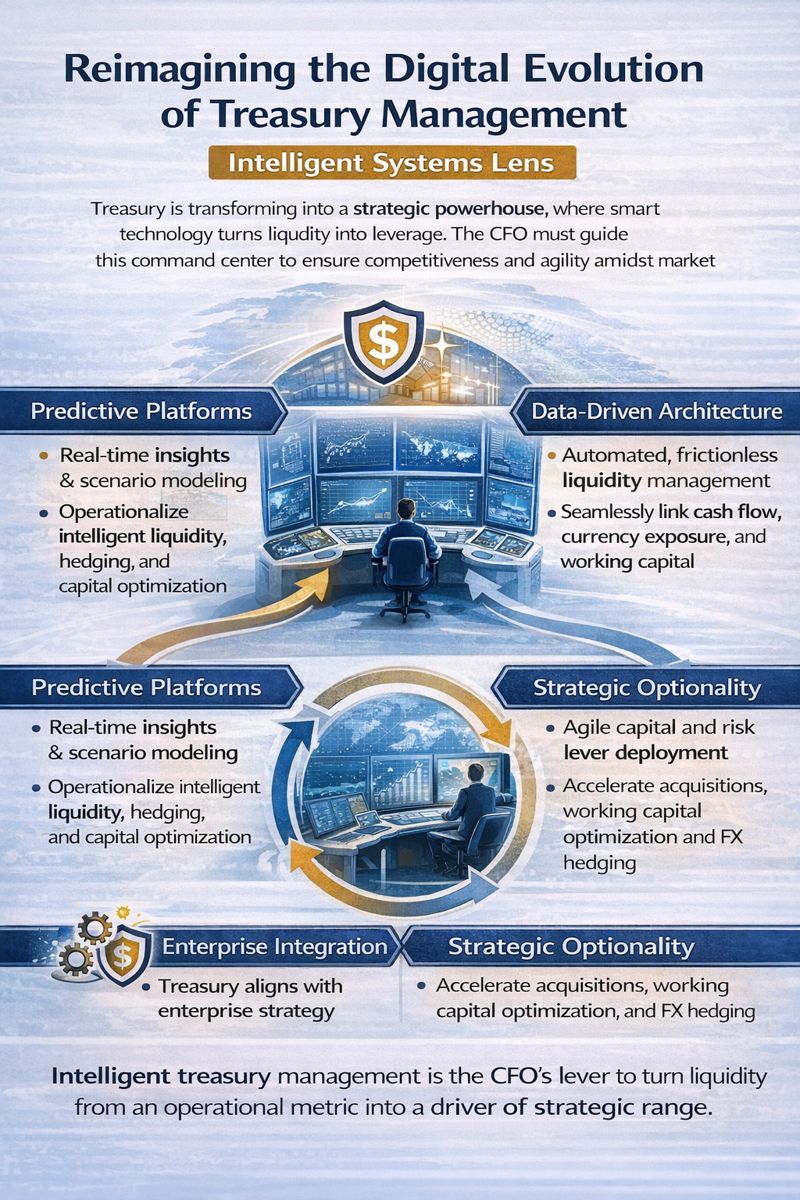
For decades, treasury has quietly served as the operational circulatory system of finance. It has managed cash, ensured liquidity, and optimized capital deployment within defined parameters. But as the velocity of business increases and digital infrastructure rewires how firms operate, the role of treasury is undergoing a profound transformation. Having served as operational CFO with over three decades of experience managing treasury operations, securing credit facilities including an eight million dollar credit line, managing working capital for a one hundred twenty million dollar logistics enterprise, and leading capital allocation across organizations that scaled from nine million to one hundred eighty million dollars in revenue, I have witnessed the shift from spreadsheet-based forecasting to artificial intelligence-powered scenario planning, from manual bank interfaces to application programming interface-driven treasury networks, and from siloed decisions to integrated treasury intelligence. The modern treasury is evolving from a back-office custodian into a digital command center, one that spans liquidity, currency exposure, financial risk, and strategic capital optimization. This comprehensive article explores how digital evolution is reimagining treasury across four dimensions: strategic reframing, operational architecture, capital agility, and enterprise integration. The outcome is not just better cash flow. It is better optionality at lower cost and with higher confidence.
Part I: From Custodian to Command Center
Traditionally, treasury sat at the center of three operational mandates: managing liquidity across accounts and entities, executing payments and collections efficiently, and hedging financial risks such as foreign exchange or interest rates. These tasks were performed through a combination of enterprise resource planning modules, bank portals, and spreadsheets, manually reconciled, periodically reviewed, and often decoupled from the rhythm of strategic decision-making.
The limitations were evident. Static cash forecasts lacked real-time accuracy. Intercompany cash flows created friction and inefficiencies. Foreign exchange and interest exposures were analyzed retrospectively. Capital deployment decisions were slow, fragmented, and reactive. In an age where volatility is persistent and speed is strategic, this model is no longer tenable.
During my time managing treasury operations across multiple organizations, I experienced these limitations directly. When I secured an eight million dollar credit line for a nonprofit organization, the forecasting process required weeks of manual consolidation across multiple entities and funding sources. By the time we completed the analysis, market conditions had shifted. Similarly, when managing working capital for a one hundred twenty million dollar logistics and wholesale enterprise, the lag between cash position reporting and decision-making meant we often discovered optimization opportunities only after they had passed.
The Digital Inflection Point
The first wave of digital treasury upgrades focused on tools: treasury management systems, electronic bank account management, and payment factories. But the real inflection came when these tools evolved into platforms, cloud-based, application programming interface-enabled, data-integrated systems that function not as accessories to finance but as its infrastructure. The modern treasury platform is characterized by real-time data ingestion from banks, enterprise resource planning systems, payment providers, and market feeds; embedded analytics for cash positioning, liquidity stress testing, and scenario modeling; automation of repetitive workflows like pooling, foreign exchange execution, and reconciliation; and integration with financial planning and analysis, risk management, and capital markets.
This shift enables CFOs to see liquidity not as a lagging indicator but as a live signal, informing operational priorities, investment pacing, and even mergers and acquisitions timing. Having overseen over one hundred fifty million dollars in acquisition transactions, I learned that deal timing depends critically on liquidity positioning and capital availability. Real-time treasury visibility transforms how companies evaluate acquisition opportunities and negotiate terms.
Treasury as Source of Strategic Optionality
Liquidity is freedom. When managed dynamically, it gives companies optionality: the ability to pre-fund growth initiatives when markets are favorable, the confidence to invest in talent, technology, or acquisitions during downturns, and the agility to defend margins through hedging or pricing strategies. In one software as a service company, the real-time treasury dashboard enabled the CFO to pause hiring in low-retention geographies based on weekly cash burn shifts. That decision saved the company from a mid-year financing round and gave it better leverage in its next valuation negotiation.
In another firm, integrating treasury analytics into financial planning and analysis allowed treasury to simulate cash impact under multiple go-to-market scenarios, resulting in a capital-light channel strategy that doubled cash runway. Treasury, when digital and integrated, becomes not a function. It becomes an edge. My experience managing capital allocation and securing over one hundred twenty million dollars in capital across multiple fundraising processes taught me that strategic optionality is the most valuable but least visible asset on the balance sheet. Treasury provides that optionality.
Part II: Building the Operating System for Digital Treasury
If strategic reframing makes the case for reimagining treasury’s role, operational architecture focuses on how that vision comes to life. Building the operating system for digital treasury requires more than a technology stack. It demands a systemic rethink of workflows, data flows, decision rhythms, and stakeholder collaboration. The digital treasury is not a single platform. It is a layered ecosystem where people, processes, and platforms converge in real time to drive liquidity, optimize capital, and mitigate risk.
Foundational Blueprint and Systems Architecture
Before building systems, CFOs must redefine the function. The modern treasury mandate spans liquidity intelligence with real-time visibility into cash, liquidity pools, and working capital; financial risk management with proactive hedging of foreign exchange, interest rate, and credit risk; capital orchestration with efficient deployment of cash across jurisdictions, entities, and instruments; and decision enablement with integration of treasury data into strategic planning and scenario modeling.
At the heart of digital treasury is the technology stack. The ideal setup typically includes a treasury management system with real-time cash positioning, foreign exchange exposure, and payment execution; bank connectivity layers through application programming interfaces, SWIFT, or aggregators; integration with enterprise resource planning, financial planning and analysis, and business intelligence tools for planning and analytics; and automation engines for payment routing, intercompany netting, and hedging execution.
Having implemented enterprise resource planning systems including NetSuite and Oracle Financials with integrated treasury modules, and having designed business intelligence architectures using MicroStrategy and Domo that connected treasury data to operational and financial dashboards, I learned that integration is where value multiplies. Isolated systems provide isolated insights. Integrated systems enable holistic optimization.
Workflow Redesign and Data Infrastructure
Technology alone does not drive value. Workflow redesign ensures that forecasting is continuous, not quarterly; payment approvals align with liquidity positions; foreign exchange hedging is tied to rolling forecasts, not static budgets; and intercompany funding is based on capital cost, not just convenience. Each workflow must be mapped to decision points, data inputs, responsible roles, and automation triggers.
A digital treasury thrives on data granularity and timeliness. CFOs must work with information technology and data teams to standardize cash flow tagging across systems, build application programming interfaces for real-time ingestion of foreign exchange rates, bank data, and internal transactions, and develop dashboards for scenario analysis and variance tracking. Treasury reports should shift from static monthly reports to daily liquidity reports with forward projections, rolling thirteen-week cash forecasts, and foreign exchange and interest rate value-at-risk dashboards.
My technical skills including SQL and experience with business intelligence platforms enable critical evaluation of data architectures and integration approaches. Modern treasury requires not just financial expertise but also technical literacy to design data flows, evaluate vendor capabilities, and troubleshoot integration issues.
Organizational Design and Governance
People are the interpreters of data and the executors of strategy. A digital treasury operating model should define roles across liquidity operations including cash, pooling, and reconciliation; risk and hedging including foreign exchange, rates, and credit; capital and funding strategy; and systems and data integrity. Skills needed include financial modeling and derivative knowledge, systems configuration and data fluency, and stakeholder communication.
Digital agility does not preclude risk management. In fact, it demands stronger controls: segregation of duties across approval, execution, and reconciliation; digital audit trails and exception alerts; and policy frameworks for exposure limits, counterparty selection, and investment thresholds. My background as a Certified Internal Auditor and experience implementing Sarbanes-Oxley controls across organizations including a public gaming company taught me that governance frameworks must be designed into systems, not layered on afterward.
Part III: Unlocking Capital Agility Through Intelligent Treasury
Capital is not a static resource. It is a velocity game. In an increasingly complex global economy, the companies that win are those that can dynamically deploy capital where it matters most, across entities, currencies, and time horizons. Treasury, once viewed as a steward of cash, is now at the forefront of this evolution. It is no longer just a cash desk. It is a capital cockpit.
From Visibility to Velocity
Traditional treasury asks where is our cash. Modern treasury asks how quickly can we move it to where it adds value. Capital agility begins with real-time visibility across accounts, banks, and legal entities. But it matures with the ability to predict inflows and outflows with higher accuracy, simulate liquidity under different planning scenarios, and execute funding transfers or hedges dynamically.
In one international software as a service company, the treasury platform identified a liquidity trap: fourteen million dollars idle in a low-interest entity due to outdated repatriation assumptions. Through entity rationalization and digital pooling, we freed up eleven million dollars in under two weeks. Treasury becomes agile when visibility is paired with activation.
Dynamic Working Capital Optimization
Working capital, including accounts receivable, inventory, and payables, is often the largest untapped source of liquidity. Intelligent treasury enables CFOs to monitor days sales outstanding and days payable outstanding in real time by region, customer segment, and payment method; simulate cash conversion cycle under different pricing or procurement terms; and identify working capital bottlenecks triggered by fulfillment delays or contract structures.
In one manufacturing firm, integrating enterprise resource planning and treasury systems allowed real-time tracking of payment delays tied to specific customer behaviors. Treasury partnered with sales to reconfigure payment terms, reducing days sales outstanding by twelve days and releasing six million dollars in working capital. Having managed supply chain analytics and logistics operations where we reduced logistics cost per unit by twenty-two percent, I learned that optimization is no longer about quarterly reviews. It is about real-time levers.
Cross-Border Liquidity and Funding Strategies
Multinational firms often face cash fragmentation, trapped liquidity due to regulatory constraints, tax inefficiencies, or operational silos. Intelligent treasury platforms support multi-entity pooling and intercompany lending rules, currency-aware repatriation strategies, and transfer pricing alignment with tax and legal teams. One global e-commerce platform operating in over forty currencies used intelligent treasury to unify foreign exchange exposure management with cash repatriation. This integrated view improved hedging accuracy and enabled faster capital movement, reducing idle balances and associated foreign exchange losses.
Treasury must also serve as the nerve center for funding strategy. Digital systems enable cash flow forecasting that anticipates funding gaps by entity and timeline, scenario modeling for drawdown timing, debt mix, and interest exposure, and monitoring of covenant risk and funding triggers in real time. In one company, a rolling thirteen-week forecast enabled precision in line-of-credit drawdowns, avoiding unnecessary interest while maintaining covenant buffers.
Embedded Risk Management
Capital agility includes protection against volatility. Intelligent treasury connects rolling foreign exchange exposure forecasts to hedge ratios and execution thresholds, and interest rate modeling to term sheet design and pricing flexibility. In a high-growth international firm, treasury analytics uncovered that unhedged revenue exposure to a depreciating currency was eroding three percent of margin annually. A realignment of hedging policy to booking cadence restored predictability without overhedging.
My certifications spanning accounting, management accounting, internal audit, production and inventory management, and project management provide the multidisciplinary framework for understanding how treasury decisions ripple through operations, risk management, and strategic planning. Foreign exchange and rate risk are not externalities. They are strategic variables.
Part IV: Embedding Treasury into Enterprise Strategy
Digital treasury is not a project. It is a capability. And capabilities do not reside in software or scorecards. They reside in the routines, conversations, and priorities that define how a company operates. In my experience across sectors and growth stages, the firms that convert treasury into an engine of advantage do not simply deploy tools. They reshape decision-making. They elevate capital awareness across the organization. And they institutionalize a bias toward precision.
From Function to Operating System
A strategic treasury capability is not an overlay. It is an undercurrent. It shows up in weekly planning meetings where liquidity risk informs pricing discussions, monthly board packs where foreign exchange sensitivity shapes earnings scenarios, and quarterly business reviews where cash utilization determines resource reallocation. This shift requires that treasury be included in enterprise planning, not just compliance cycles; report forward-looking indicators, not just trailing cash; and operate as a co-pilot to strategy, not just to accounting.
Having managed board reporting for organizations that raised over one hundred twenty million dollars in capital, I learned that boards govern what they see consistently. When treasury data appears in the same dashboards and discussions as revenue and margin, it becomes a shared concern rather than a finance-only responsibility.
Linking Treasury to Risk Governance and Incentives
Risk is not a separate track from growth. It is its complement. A digitized treasury becomes an early warning system, surfacing risks before they materialize in cash flow. Integration includes treasury participation in enterprise risk committees, dynamic dashboards on foreign exchange, interest, and counterparty exposure in board packs, and real-time thresholds triggering management reviews.
Integration falters when decision rights are fragmented or incentives misaligned. A fully embedded treasury capability requires clear accountability for liquidity outcomes within business units, bonus structures tied to capital efficiency metrics such as working capital and cash conversion, and empowering treasury to veto or escalate decisions that compromise financial agility.
Cultural Transformation and Measurement
The ultimate marker of integration is cultural. Organizations that embed digital treasury talk about capital as fluently as cost, celebrate capital discipline as a form of strategic creativity, and reward precision and planning over hustle and improvisation. Culture changes not through slogans but through rituals. Treasury must be part of those rituals.
Integration requires measurement. CFOs must define key performance indicators that reflect strategic treasury impact: forecast variance on cash flows, foreign exchange risk-adjusted earnings before interest, taxes, depreciation, and amortization, capital efficiency ratios across geographies, and liquidity mobility index measuring how easily capital moves across the system. What gets measured gets defended. What gets defended gets funded.
Conclusion: Liquidity as Leverage
In most companies, treasury has traditionally operated in the background, efficient, accurate, and largely reactive. Yet in an age marked by capital volatility, compressed decision cycles, and expanding global complexity, this legacy posture is no longer sufficient. Treasury must evolve from a control function into a command capability.
Drawing from three decades as an operational CFO across sectors and stages, I have witnessed the transformational power of treasury when digitized, integrated, and elevated. The opportunity is clear: Treasury can become a cockpit of capital, steering liquidity, mitigating risk, and amplifying strategic execution. But only if reimagined with intent.
This transformation rests on five strategic imperatives. First, reframe the role by treating treasury not as a compliance node but as a growth enabler. Second, build the system by designing architecture that delivers real-time insight, not static reports. Third, activate capital by using treasury analytics to unlock agility in working capital and funding. Fourth, integrate deeply by embedding treasury into strategy, planning, risk, and cross-functional decisions. Fifth, lead the culture by championing capital awareness across the enterprise, not just in finance.
In the most agile companies I have advised, treasury is not a cost center. It is a nerve center. A place where insight meets execution, and where financial discipline enables, not inhibits, boldness. The digital evolution of treasury is not optional. It is foundational. In the new enterprise, liquidity is not something you report. It is something you wield. And the CFO who masters it builds not just balance sheet strength but strategic range.
This is not about software. It is about signal. And the best signal in today’s capital markets is clarity, control, and capital conviction, delivered through an intelligent, integrated treasury. Based on my experience managing treasury operations, capital allocation, risk management, and strategic planning across diverse organizations and situations, I can attest that the CFOs who lead this transformation will create disproportionate value for their stakeholders. Those who treat treasury as a back-office function will find themselves managing increasingly obsolete capabilities in an increasingly dynamic world. The choice is clear. The opportunity is now.
Disclaimer: This blog is intended for informational purposes only and does not constitute legal, tax, or accounting advice. You should consult your own tax advisor or counsel for advice tailored to your specific situation.
Hindol Datta is a seasoned finance executive with over 25 years of leadership experience across SaaS, cybersecurity, logistics, and digital marketing industries. He has served as CFO and VP of Finance in both public and private companies, leading $120M+ in fundraising and $150M+ in M&A transactions while driving predictive analytics and ERP transformations. Known for blending strategic foresight with operational discipline, he builds high-performing global finance organizations that enable scalable growth and data-driven decision-making.
AI-assisted insights, supplemented by 25 years of finance leadership experience.