
Executive Summary
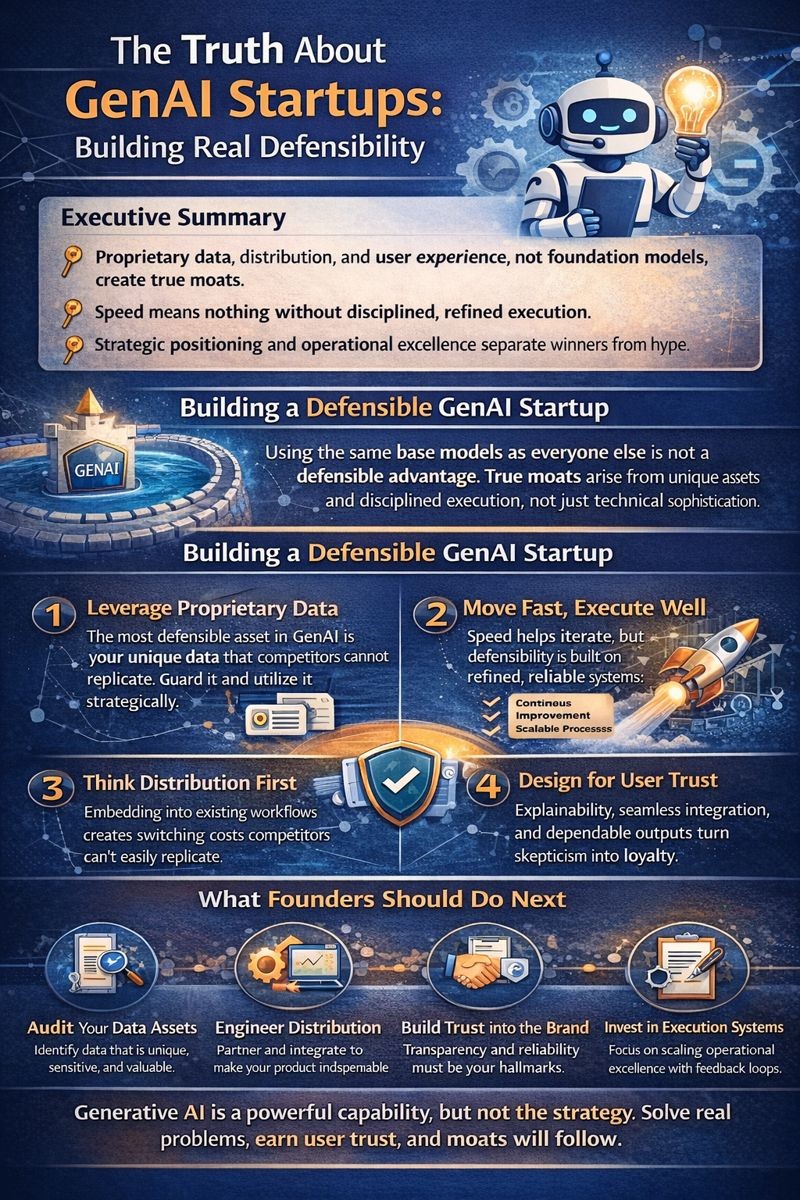
As a CFO and strategic advisor in early-stage and growth-stage companies across software as a service, logistics, medical devices, and advertising technology, I have seen technology cycles emerge, peak, and fragment. Every wave brings its own set of myths. In the generative artificial intelligence wave, one of the most persistent is the notion that a moat naturally exists because a startup is using a large language model. It does not. Having led due diligence for over one hundred fifty million dollars in acquisition transactions, managed capital raising processes that secured over one hundred twenty million dollars in funding, and advised companies from pre-revenue startups to established enterprises generating over one hundred eighty million dollars in revenue, I have learned that defensibility does not come from the model. A foundation model, whether from OpenAI, Anthropic, Google, or Meta, is not a moat. It is a raw material. What you build on top of it might become a defensible product. But the model itself, unless it is proprietary or trained on exclusive data, is a shared commodity. This article breaks down the competitive defensibility of generative artificial intelligence startups, separating proprietary data, fine-tuning, distribution, and user experience from hype, and provides practical guidance for founders and CFOs building sustainable competitive advantages in the generative artificial intelligence era.
The Dangerous Illusion of the Model Moat
Founders must internalize this truth: a foundation model is not a moat. Because the illusion of a moat is more dangerous than having none at all. It breeds false confidence. It misleads investors. And it ultimately erodes execution discipline. Having worked through multiple startup life cycles, leading due diligence, capital raises, and product-market alignment across sectors from cybersecurity to education technology to digital marketing, I learned that investors increasingly distinguish between technical sophistication and defensible competitive advantage. The former impresses in demos. The latter determines long-term success.
True defensibility in generative artificial intelligence does not arise from the model. It emerges from data, distribution, integration, and product intuition. My experience implementing enterprise resource planning systems, business intelligence architectures, and operational analytics platforms across organizations taught me that technology is rarely the sustainable differentiator. Sustainable advantage comes from how technology combines with proprietary assets, market positioning, and operational execution.
Data as the First and Last Moat
Start with the only real scarcity in artificial intelligence: proprietary data. Every meaningful generative artificial intelligence application depends on fine-tuned context. If a company can uniquely access a corpus of data that no competitor can replicate, whether medical imaging archives, customer support transcripts, industry-specific documentation, or usage telemetry, that becomes the core advantage.
In a vertical software as a service company, the team trained a large language model on a decade of customer onboarding conversations and product feature usage. This model did not just generate generic help responses. It understood the nuance of customer churn triggers, integration bottlenecks, and onboarding sentiment. That is not just artificial intelligence. It is domain-informed artificial intelligence. And it was only possible because the data was not available publicly.
During my time leading revenue operations and deal desk functions for a cybersecurity and professional services company, we captured detailed data on deal negotiations, pricing discussions, customer objections, and contract terms. This proprietary dataset became the foundation for artificial intelligence-powered pricing optimization that outperformed generic models because it reflected our specific customer dynamics, competitive positioning, and win-loss patterns. No competitor could replicate that advantage without years of similar data collection.
If you are a founder, ask yourself: what data do we own that nobody else can access? What contracts, usage behavior, or proprietary knowledge sits behind our firewall? That is your competitive DNA. Guard it. Structure it. Build defensibility around it. My background as a Certified Internal Auditor emphasizes data governance and protection. Proprietary data is both a competitive asset and a fiduciary responsibility requiring appropriate security controls, access management, and compliance frameworks.
Fine-Tuning Is Necessary But Not Sufficient
The second myth is that fine-tuning a foundation model creates a moat. It does not, at least not on its own. Fine-tuning helps localize intelligence. It helps the model speak your customer’s language and operate within your business logic. But unless that fine-tuning reflects unique domain expertise built on proprietary data, it remains replicable.
In one advertising technology platform where I led financial planning and analysis, the team fine-tuned a model to generate ad copy variations based on past campaign performance. The fine-tuning yielded better click-through rates. But within six months, a competitor released a similar feature, cheaper, faster, and with broader integrations. Why? Because both teams were pulling from a common dataset of digital ad structures and engagement signals. The fine-tuning provided operational benefit but not strategic defensibility.
The takeaway is simple. Fine-tuning is table stakes. If everyone has access to the same base models and similar training data, differentiation comes from elsewhere. Having implemented financial planning and analysis automation and business intelligence systems across multiple organizations, I learned that technical capability quickly becomes commoditized. Sustainable advantage comes from how that capability combines with unique assets, market positioning, and operational excellence.
Distribution: The Strongest, Least Understood Moat
For early-stage generative artificial intelligence startups, the strongest moat often is not technical. It is go-to-market. Who you reach, how fast you reach them, and how well your product becomes embedded in their workflow. I have seen brilliant artificial intelligence tools fail because they relied on self-serve virality that never materialized. I have also seen technically mediocre tools succeed because they integrated directly into a revenue team’s quote-to-cash workflow, or embedded themselves in a procurement dashboard, or solved a recurring compliance issue for general counsel.
The best founders think about distribution before they think about deployment. They ask: what existing workflow can we replace or augment with intelligence? How do we reduce the distance between user and value? And most importantly: how do we make the user forget they are using artificial intelligence at all?
During my time scaling companies from nine million to one hundred eighty million dollars in revenue, I witnessed how distribution determines success more than product superiority. The companies that won were not always those with the best technology. They were those that reached customers fastest, integrated deepest, and created highest switching costs through workflow embeddedness. When we implemented NetSuite and OpenAir professional services automation at a cybersecurity company, the value came not from technical features but from how seamlessly these systems integrated into daily workflows, making them indispensable.
In one compliance automation company, the founder embedded the generative artificial intelligence agent directly into the legal team’s document review interface. The agent did not just highlight risk. It explained why, citing historical clause variants and court interpretations. It became indispensable not because it was perfect but because it was perfectly placed. This is distribution as moat: being where decisions happen, not where conversations occur.
User Experience as Competitive Differentiator
Generative artificial intelligence products still struggle with user experience. They either present too much output or hide too much process. The future winners will design for explainability. Users will not trust opaque black boxes. They want transparency. They want control. And they want to see how a system reasons.
Founders should treat generative artificial intelligence interfaces not as chatbots but as interfaces for decision design. In one medical technology startup, the generative artificial intelligence agent presented diagnostic recommendations alongside confidence intervals and reference sources. Doctors could toggle between recommendations, view underlying logic, and even challenge the assumptions. That level of transparency turned skepticism into trust.
User experience is not a layer. It is the product. The best generative artificial intelligence companies understand this. They design feedback loops, user agency, and explainable models into the core of their offering. They do not chase raw power. They deliver usable intelligence. Having designed key performance indicator frameworks and business intelligence dashboards using MicroStrategy and Domo across multiple organizations, I learned that adoption depends on user experience more than analytical sophistication. The most powerful analytics are worthless if users find them difficult to access, interpret, or trust.
My project management certification emphasizes that user adoption is the ultimate measure of implementation success. Technical functionality matters less than whether users embrace and rely on the system. This principle applies doubly to artificial intelligence systems where explainability and trust are prerequisites for adoption.
Speed Is Not a Moat, But Execution Is
Some founders mistake speed of iteration for defensibility. They think launching fast is the edge. It is not. Anyone with access to a model can ship a product in days. But few can build systems of refinement, feedback capture, and reliability at scale. Execution moats are built through operational excellence: onboarding flows, data hygiene, customer success, usage analytics, model governance. These are the boring, durable systems that determine whether a generative artificial intelligence product becomes an everyday tool or a novelty.
I observed this firsthand in a logistics technology firm where we deployed an artificial intelligence-powered routing assistant. The first iteration worked, but customers struggled with reliability. Rather than overpromise, the company implemented a continuous learning loop. Every feedback event was tagged, triaged, and routed into the training set. Within three quarters, reliability jumped by thirty-five percent and customer satisfaction doubled. That is execution. That is a moat.
Having managed supply chain analytics for a one hundred twenty million dollar logistics and wholesale enterprise, where we reduced logistics cost per unit by twenty-two percent, I learned that operational excellence creates sustainable advantage. The optimization came not from a single brilliant insight but from systematic process improvement: data quality, feedback loops, continuous refinement, and operational discipline. These capabilities take time to build and are difficult for competitors to replicate.
The Brand of Trust in Regulated Industries
In regulated industries including finance, healthcare, and legal, your most important moat is trust. Not speed. Not model size. Trust. Founders building generative artificial intelligence applications in sensitive domains must earn trust with every feature. That means audit trails, human override, policy enforcement, and outcome reproducibility.
In a financial services application, we enforced mandatory model disclosures with every recommendation: data sources, assumptions, and confidence thresholds. Initially, it slowed adoption. Over time, it became our brand. Investors loved it. Auditors respected it. Customers relied on it. Trust compounds like capital.
My background implementing Sarbanes-Oxley controls and managing internal audit functions across organizations including a public gaming company taught me that trust is earned through transparency, consistency, and accountability. When we implemented automated revenue recognition that increased accuracy by twenty-eight percent, adoption succeeded because we provided complete audit trails showing how each transaction was classified and why. Users could validate the logic, override when necessary, and understand the reasoning. This transparency built trust that enabled autonomous operation.
Similarly, when I secured over one hundred twenty million dollars in capital across multiple fundraising processes, investor confidence came from transparency about assumptions, risks, and governance. The same principle applies to generative artificial intelligence products. Explainability is not a compliance checkbox. It is a strategic advantage that builds trust and reduces friction.
Strategic Positioning: GenAI Is a Feature, Not a Strategy
The most important lesson I share with founders is this: generative artificial intelligence is not a strategy. It is a capability. Your strategy is the problem you solve and the behavior you change. If generative artificial intelligence helps you do that more elegantly, more scalably, or more intelligently, then use it. But never lead with it.
Products that lead with artificial intelligence quickly become indistinguishable. Everyone claims they have the smartest model. Few can prove they solve the sharpest problem. Position your company around a customer pain point that generative artificial intelligence happens to solve. That is the difference between a feature and a company.
Throughout my career advising companies across sectors and stages, from pre-revenue startups to public enterprises, I learned that successful companies are defined by the problems they solve, not the technologies they use. Technology is the how, not the why. When we scaled organizations from nine million to one hundred eighty million dollars in revenue, growth came from solving increasingly valuable customer problems, not from adopting increasingly sophisticated technologies.
The Capital Markets Will Catch Up
Right now, generative artificial intelligence startups often attract capital based on model complexity, demo sophistication, or perceived market size. But this exuberance will narrow. Investors will soon ask harder questions: What proprietary signals do you capture? What usage behavior do you own? What switching costs exist? How do you defend your margins?
As a CFO who has managed board reporting, investor relations, and capital allocation across multiple funding rounds and stages, I believe it is better to answer those questions now, before the board does. My certifications spanning accounting, management accounting, and internal audit provide the analytical framework for evaluating sustainable competitive advantage versus temporary technical leadership.
During due diligence for acquisition transactions totaling over one hundred fifty million dollars, I learned that acquirers care about defensibility, not demos. They ask whether competitive advantage is real or replicable, whether customer relationships are sticky or transactional, whether unit economics improve with scale or deteriorate. Founders building generative artificial intelligence companies must answer these questions credibly.
What Founders Should Do Next
Based on thirty years of financial leadership, strategic advisory, and operational execution across diverse sectors and stages, I offer this guidance:
First, audit your data assets. Inventory what you have that competitors cannot replicate. Classify it by uniqueness, sensitivity, and leverage potential. Data governance is both competitive strategy and fiduciary responsibility.
Second, design your moat around behavior, not just intelligence. Ask: where do we sit in the workflow, and how hard would it be to displace us? Distribution and integration create switching costs that technical superiority alone cannot.
Third, build trust as part of your brand. Explainability is not a compliance checkbox. It is a product advantage. Transparency builds credibility with users, confidence with investors, and defensibility against competitors.
Fourth, treat distribution as engineering. Invest in integrations, partnerships, and embedded use cases. Make your product unavoidable, not just interesting. The best technology loses if it reaches customers last.
Fifth, invest in execution systems. Operational excellence including onboarding, feedback loops, data quality, and continuous improvement creates moats that competitors cannot copy through better models alone.
Conclusion
Finally, remind yourself and your team that generative artificial intelligence is not the story. It is the ink. Your job is to write a story worth reading. The story is the problem you solve, the behavior you change, and the value you create. Generative artificial intelligence is simply the tool that makes that story more compelling, more scalable, and more defensible.
The generative artificial intelligence wave will produce both winners and casualties. Winners will be those who combine technical capability with proprietary assets, deep distribution, trusted brands, and operational excellence. Casualties will be those who mistake foundation models for moats and demos for defensibility.
As someone who has built, scaled, advised, and invested in companies across three decades and multiple technology cycles, I can tell you that the fundamentals do not change. Sustainable competitive advantage comes from solving important problems better than alternatives, creating switching costs through integration and trust, and executing with operational discipline that compounds over time. Generative artificial intelligence is a powerful new tool for building these advantages. But it is a tool, not a strategy. Use it wisely.
Disclaimer: This blog is intended for informational purposes only and does not constitute legal, tax, or accounting advice. You should consult your own tax advisor or counsel for advice tailored to your specific situation.
Hindol Datta is a seasoned finance executive with over 25 years of leadership experience across SaaS, cybersecurity, logistics, and digital marketing industries. He has served as CFO and VP of Finance in both public and private companies, leading $120M+ in fundraising and $150M+ in M&A transactions while driving predictive analytics and ERP transformations. Known for blending strategic foresight with operational discipline, he builds high-performing global finance organizations that enable scalable growth and data-driven decision-making.
AI-assisted insights, supplemented by 25 years of finance leadership experience.