



Executive Summary
In the long corridors of operational finance, there is a quiet revolution underway. While enterprise resource planning systems still hum with the gravity of balance sheets and order quantities, an intelligent stratum has begun to emerge above them. It is a stratum that does not just record but predicts. It does not just approve suppliers but evaluates them on hundreds of variables in real time. Having implemented enterprise resource planning systems including NetSuite and Oracle Financials, integrated e-sourcing platforms, designed business intelligence architectures, and managed procurement operations for organizations spanning from nine million to one hundred eighty million dollars in revenue, I have witnessed this transformation firsthand. This is the rise of the procurement tech stack, not as a collection of disparate tools but as a symphony of orchestration that includes enterprise resource planning, e-sourcing platforms, and artificial intelligence-driven risk monitoring. When done right, it becomes not just an automation layer but a cognitive partner to the procurement strategist. This article explores how to bridge the gap between tools and strategy, transforming procurement from transactional efficiency to anticipatory intelligence.
Crossing the Chasm: From Early Adoption to Mainstream Integration
Geoffrey Moore’s Crossing the Chasm offers a prescient roadmap for this transformation. At its core, the book addresses the perilous gap that exists between early adopters of a technology and the early majority who demand demonstrable return. The innovators marvel at the tool’s potential. The pragmatists need integration, results, and governance. In procurement, the same canyon yawns between pioneering chief procurement officers experimenting with artificial intelligence-led supplier segmentation and the broader procurement community which insists that systems interoperate with SAP or Oracle, deliver real compliance value, and map to the general ledger.
Moore speaks about the importance of a whole product strategy. In procurement parlance, this means the integration of artificial intelligence modules with enterprise resource planning, data lakes with e-sourcing suites, and predictive analytics with real-world supplier performance. A language of orchestration must replace the lexicon of fragmentation. The challenge is not the technology. It is the behavioral economics of adoption. Procurement teams, often trained in risk aversion and cost control, are asked to embrace probabilistic models and dynamic scoring. This is a cultural chasm, not merely a technological one.
During my time implementing enterprise resource planning systems and integrating them with Salesforce, business intelligence platforms, and operational analytics tools across multiple organizations, I experienced this adoption challenge repeatedly. The technology worked. But adoption lagged until we demonstrated clear value in terms that procurement teams understood: faster cycle times, better compliance, improved supplier quality, reduced maverick spend. This is Moore’s whole product concept in action.
To cross the chasm, Moore suggests beachhead strategies: focus tightly on one buyer persona and one use case. The lesson is powerful. In procurement transformation, it is wiser to first deploy artificial intelligence risk monitoring on geopolitical supplier exposure for critical inputs than to attempt a sweeping AI integration across the entire value chain. This singular deployment must be airtight in its return and clear in its outcome. Once secured, it becomes the cornerstone to scale.
My project management certification and experience leading implementations taught me that phased rollouts with clear success criteria drive adoption more effectively than big bang approaches. When we implemented NetSuite with integrated procurement modules at a cybersecurity company, we started with one business unit, demonstrated value, refined processes, then expanded. This beachhead strategy built organizational confidence and political support for broader transformation.
Strategic Cost Management: From Containment to Leverage
This need for clarity in value creation connects to Vijay Govindarajan and John Shank’s Strategic Cost Management, a masterful framework that unbundles cost from its inert identity and repositions it as a lever for value. Where many treat technology as overhead to absorb, Govindarajan reframes it as a source of cost advantage, one that emerges from the alignment of structural cost drivers with strategic intent. Within procurement, the clarity of this thinking is transformative. An enterprise resource planning system alone may reduce transaction cost but does not optimize spend. An e-sourcing platform may digitize bids but does not inherently improve supplier quality. Artificial intelligence might flag anomalies but unless embedded into upstream sourcing design, its strategic lift is muted.
What Govindarajan calls for is a value chain view of cost. In the procurement tech stack, that means evaluating not just the software subscription but the degree to which the combined stack reduces total cost of ownership across the sourcing life cycle, from requisition to contract to settlement. It means measuring whether the visibility provided by artificial intelligence risk monitors helps avoid costly disruptions or whether automated supplier scoring reduces cycle time and litigation risk. The financial models must distinguish between short-term operating expense outlays and the long-term strategic moat they provide.
Having managed supply chain analytics for a one hundred twenty million dollar logistics enterprise, where we reduced logistics cost per unit by twenty-two percent through data-driven optimization, I learned that Govindarajan’s framework is not theoretical. It is operational. The reduction came not from cutting costs indiscriminately but from understanding cost drivers: routing efficiency, carrier consolidation, demand forecasting accuracy, and warehouse placement. Technology enabled the analysis. Strategy determined which insights to act on. The combination created sustainable competitive advantage.
The Intelligence Layer: Risk Management Reimagined
The risk management dimension, increasingly driven by machine learning and natural language processing applied to supplier data, presents a new paradigm. Gone are the days when risk meant a line in the balance sheet or a tick in the contract clause. Today’s risk is reputational, geopolitical, environmental, and network-based. Artificial intelligence helps translate that entropy into signal. But as Crossing the Chasm reminds us, early prototypes and pilots must give way to a mature, scalable architecture. That requires rigor not just in the algorithms but in the data governance, workflow automation, and board-level dashboards that interpret them.
My background as a Certified Internal Auditor informs this perspective. Risk management requires not just identification but mitigation, monitoring, and governance. When I implemented Sarbanes-Oxley controls and managed internal audit functions across organizations including a public gaming company, I learned that control frameworks must be embedded in systems, not layered on top through manual procedures. The same principle applies to procurement risk management. Artificial intelligence-powered risk scoring must integrate directly into approval workflows, not generate separate reports that procurement teams may or may not review.
This emerging intelligence layer is at once exciting and cautionary. Exciting because it finally gives procurement leaders the tools to drive foresight. Cautionary because poorly deployed, it adds cost without clarity. Procurement systems can become disconnected if not designed with a full-product mentality. The artificial intelligence model is not enough. What matters is whether it links to the supplier onboarding process, whether it triggers alerts through the same channels buyers already use, whether the finance team can see the implication on working capital in real time.
Orchestration as Strategic Architecture
In the CFO’s office, I often find that the ultimate barometer of technology’s value is not its elegance but its coherence with control systems. Procurement systems, when intelligent, must still map cleanly into audit trails. They must support governance. They must provide a clear trail of supplier evaluation criteria, their changes, their overrides, and the resulting decisions. Artificial intelligence can enrich the judgment, but it cannot obfuscate it. Procurement is the gatekeeper not only of spend but of enterprise integrity.
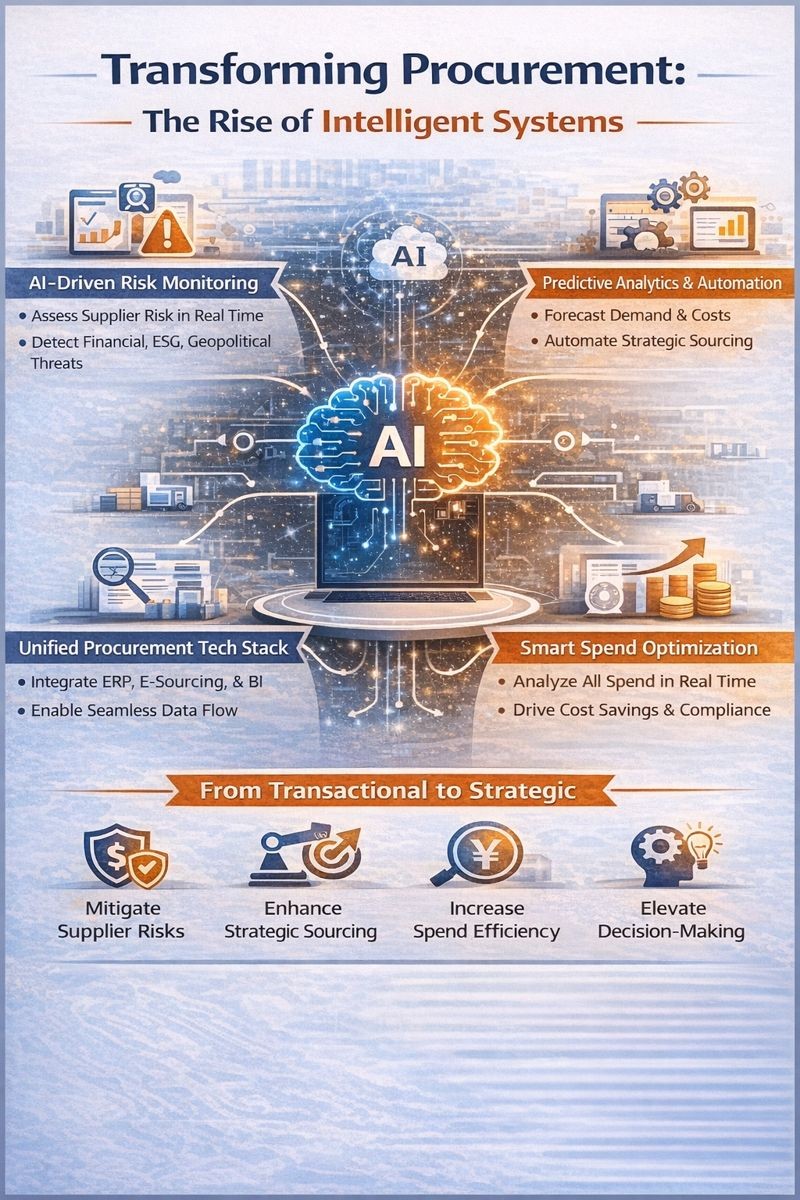
When e-sourcing platforms first emerged, they promised efficiency through digitized requests for proposals. That promise is now table stakes. The modern vision must evolve: Can the system adapt to changing global sanctions in real time? Can it compare not just price but resilience? Can it reconfigure sourcing strategy based on environmental and social governance breaches or logistics delays? These are no longer hypothetical questions. The underlying artificial intelligence and data infrastructure exists. What is needed is orchestration across enterprise resource planning anchors, sourcing tools, artificial intelligence overlays, and human oversight.
This orchestration is the equivalent of Moore’s whole product. It is what Govindarajan would call a source of cost leadership through strategic positioning, not just internal optimization. It turns procurement from a tactical function to a source of strategic agility. Having implemented business intelligence systems including MicroStrategy and Domo that integrated data from enterprise resource planning, customer relationship management, and operational systems, I learned that integration is where value multiplies. Isolated systems provide isolated insights. Integrated systems enable holistic optimization.
From System of Record to System of Intelligence
The most valuable systems in business are not those that reduce human labor but those that elevate human judgment. In procurement, this truth is fast becoming central. What was once a function of transactional clarity is now a field of anticipatory decision-making. Whether the decision is about onboarding a supplier in Vietnam, switching a logistics route to avoid political unrest, or flagging anomalies in compliance clauses, the procurement tech stack must now operate as a system of intelligence, not simply a system of record.
In practice, this requires that systems do not merely speak to each other but reason together. Artificial intelligence-based supplier risk scores must inform sourcing thresholds, which must then be linked back to enterprise resource planning-based approval workflows. A supplier flagged as medium-risk by the artificial intelligence engine should automatically trigger an additional legal review or a finance override, not through a memo but through native workflow. This is the orchestration we speak of. And it requires not only technical architecture but governance consensus across finance, compliance, procurement, and operations.
Drawing from my own leadership experience implementing revenue recognition automation that increased accuracy by twenty-eight percent and improving month-end close from seventeen days to under six days, I learned that transformation succeeds when systems support rather than disrupt existing workflows. The automated revenue recognition system integrated with our enterprise resource planning and customer relationship management systems, generating journal entries that flowed directly into the general ledger. Users did not need to learn entirely new processes. The system enhanced what they already did.
Metrics That Matter: Procurement Resilience
Aligning stakeholders begins with a shared metric. In one transformation, we introduced the concept of procurement resilience score, a weighted index incorporating lead-time variability, environmental and social governance compliance history, geopolitical exposure, and financial viability. The key was not merely building the model but ensuring that its output fed directly into planning, contract design, and budget forecasting. We had crossed the chasm from insight to impact.
This leads to an important lesson from Crossing the Chasm: mature adoption is less about the technology and more about its encapsulation within the existing logic of the business. Moore speaks about the importance of use-case orientation. For procurement, this means deploying artificial intelligence and e-sourcing tools in line with where the pain is highest and the value most measurable. For instance, in direct procurement where quality and lead time are mission-critical, automated supplier evaluations have high return on investment. In indirect procurement, contract compliance automation can deliver immediate payback. The key is to build trust in the system by showing its impact, not touting its potential.
My certification in production and inventory management provides the operational foundation for understanding these use cases. Direct materials procurement for manufacturing requires different metrics and controls than indirect procurement for professional services. The technology stack must accommodate these differences while maintaining consistent governance and data standards.
Cognitive Learning and Enterprise Memory
Yet there remains one frontier that few procurement teams have fully tackled: cognitive learning. Artificial intelligence engines trained on historical supplier data, compliance clauses, or dispute outcomes must continuously improve. But for this learning to be useful, it must be feedback-looped into procurement behaviors. A machine that flags a certain contract clause as risky must also track whether the buyer ignored the warning and whether that decision led to an issue downstream. This is not mere analytics. It is enterprise memory. And it is here that the procurement tech stack must evolve into an enterprise nervous system.
This nervous system also serves a strategic role in managing reputation. In the age of instantaneous media cycles and activist shareholders, a single environmental and social governance failure or supplier scandal can destroy brand equity. Artificial intelligence-driven monitoring of supplier media exposure, carbon disclosures, and human rights compliance is no longer optional. It is fiduciary. But the value of these tools is only realized when the insights are acted upon. The best artificial intelligence models in the world are useless if procurement governance lacks the agility to act on them quickly.
Conclusion: Systems Thinking for Strategic Advantage
In closing, the orchestration of enterprise resource planning, e-sourcing, and artificial intelligence-driven risk monitoring is not a question of tools. It is a question of systems thinking. It is where Govindarajan’s cost strategies meet Moore’s adoption curve. It is where procurement becomes a model of enterprise intelligence, not simply expense control. As financial and operational leaders, our task is not to merely deploy software. It is to design a decision architecture that aligns technology with foresight, cost with purpose, and systems with strategy.
Having implemented technology systems, built procurement capabilities, and managed supply chain operations across diverse organizations and sectors, I can attest that the future of procurement is not just digital. It is intelligent. The organizations that master this orchestration will achieve cost advantages, risk mitigation, and strategic agility that competitors using fragmented tools cannot match. The transformation requires investment in technology, governance, and capability building. But the payoff is sustainable competitive advantage built on superior decision-making, enabled by systems that elevate rather than replace human judgment.
Disclaimer: This blog is intended for informational purposes only and does not constitute legal, tax, or accounting advice. You should consult your own tax advisor or counsel for advice tailored to your specific situation.
Hindol Datta is a seasoned finance executive with over 25 years of leadership experience across SaaS, cybersecurity, logistics, and digital marketing industries. He has served as CFO and VP of Finance in both public and private companies, leading $120M+ in fundraising and $150M+ in M&A transactions while driving predictive analytics and ERP transformations. Known for blending strategic foresight with operational discipline, he builds high-performing global finance organizations that enable scalable growth and data-driven decision-making.
AI-assisted insights, supplemented by 25 years of finance leadership experience.