
Executive Summary
In the lexicon of enterprise risk, supplier due diligence has traditionally been a low-velocity function, emerging during onboarding, surfaced again during audits, and usually buried in checklists that say more about compliance than about consequence. But the world in which those static checklists were useful is gone. We now inhabit an interdependent lattice of cyber exposure, geopolitical volatility, financial contagion, and environmental and social governance scrutiny, each variable amplifying the next, and each capable of rendering even a vetted supplier unexpectedly fragile. Having managed supply chain analytics for a one hundred twenty million dollar logistics enterprise, negotiated master service agreements spanning years and tens of millions in cumulative volume, and implemented production and inventory management systems across multiple organizations, I have learned that supplier fragility does not announce itself with spreadsheets. It accumulates in shadows through financial strain, cyber lapses, or indirect exposure to secondary geographies under duress. This essay explores how complexity-informed due diligence frameworks combined with scenario modeling can transform supplier risk management from compliance exercise to strategic capability.
When Supply Chains Meet Complexity Theory
My own evolution in supplier risk modeling has been shaped not only by financial logic but by systems thinking. The best modeling frameworks are not those that seek to eliminate disorder but those that internalize it, structures that survive by being adaptive, not by being armored. A supplier network is not a linear pipeline. It is a dynamic, semi-ordered system that must be stress-tested like any other complex system.
In one instance, a supplier appeared robust by every traditional metric: profitable, consistent, with a clean audit trail. Yet scenario analysis revealed that sixty-two percent of their business was tied to a single customer located in a region facing rising geopolitical risk. Their fragility was not financial but structural. The lesson was unmistakable: risk visibility requires scenario modeling that is informed not just by data but by systems logic.
My certification in production and inventory management provides the operational foundation for understanding supply chain complexity. Supply chains are not just procurement functions. They are integrated systems where demand forecasting, production scheduling, inventory positioning, and supplier capability must work in concert. Disruption in any node cascades through the system. During my time managing logistics and supply chain operations, I witnessed how a port strike in one region rippled through inventory levels, production schedules, and customer delivery commitments across multiple continents.
Building Complexity-Informed Due Diligence
To build a complexity-informed due diligence framework, we must begin by segmenting suppliers not by spend but by impact and volatility. I have found success with a three-dimensional risk topology: exposure defined by volume, criticality, and substitutability; fragility measured through financial ratios, operational concentration, and cyber-readiness; and adaptability assessed via governance, digital maturity, and responsiveness to change. High-impact, high-fragility, low-adaptability suppliers are where most risk resides and where traditional vendor due diligence often falls short.
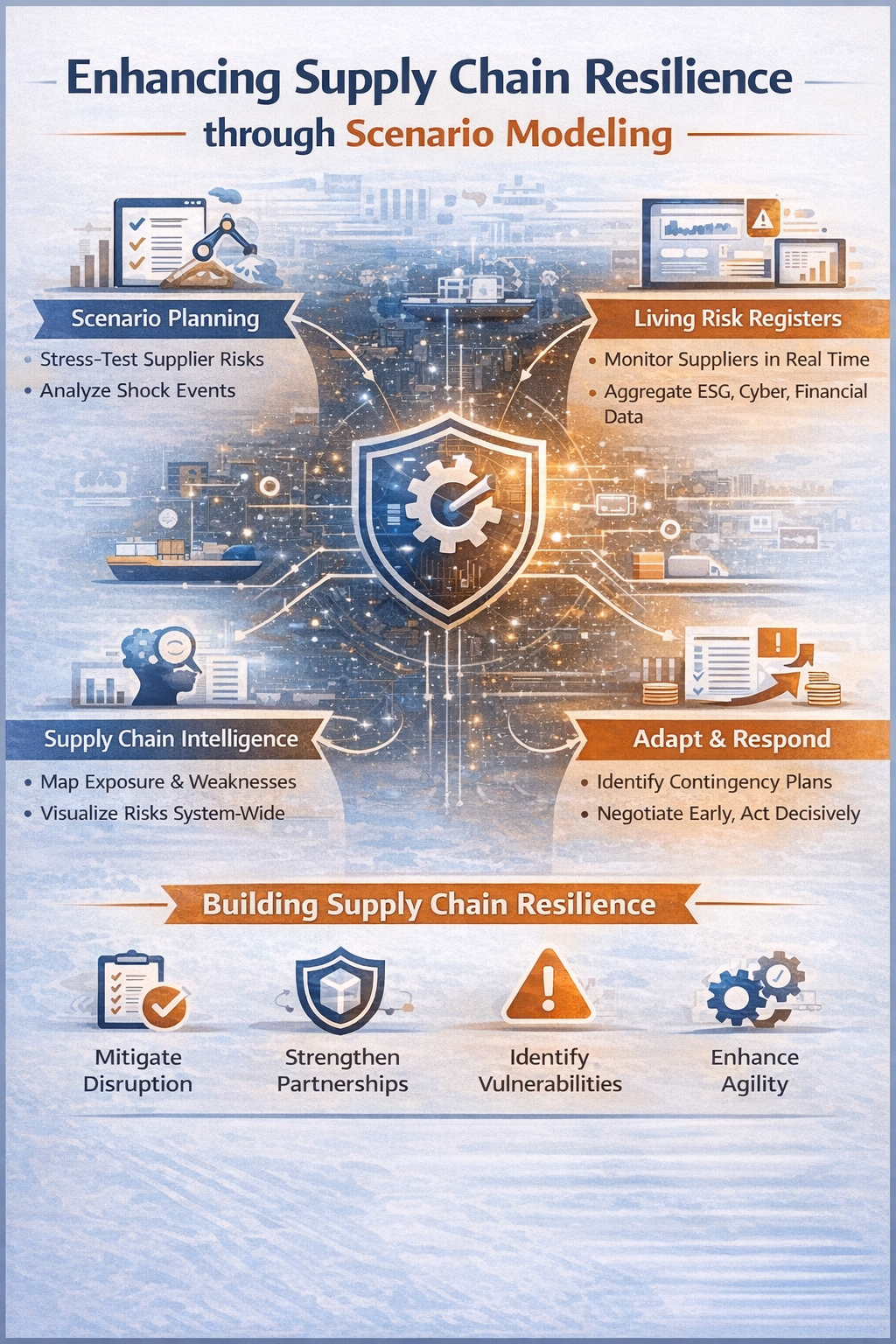
This is where stress testing becomes essential. A robust framework must simulate shock events: cyber breach propagation, raw material shortages, foreign exchange volatility, geopolitical disruption, or regulatory crackdown. But stress testing must go beyond hypotheticals. It must be connected to governance. If a supplier fails a scenario test, what are the fallback mechanisms? What are the early warning signals? Do master service agreements contain step-down clauses, audit triggers, and transition frameworks?
Too often, I have reviewed master service agreements that were allowed to expire unnoticed. Without amendment or renewal, they became hollow vessels, terms that could not be enforced and obligations that could not be activated. One of my operating principles is now simple but non-negotiable: no supplier of consequence should remain under an expired master service agreement. Where expiration has occurred, an amendment at minimum must be crafted to reassert commercial and operational boundaries.
My background as a Certified Internal Auditor informs this governance perspective. Just as we audit financial controls for effectiveness, we must audit supplier relationships for contractual validity, risk exposure, and alignment with current business needs. During my time implementing Sarbanes-Oxley controls and managing internal audit functions across organizations including a public gaming company, I learned that governance frameworks prevent small issues from becoming major crises.
The Living Supplier Risk Register
To enable continuous risk management, I advocate for a living supplier risk register. This is not a static log but a scenario-fed platform that scores suppliers dynamically across dimensions. Integrating feeds from environmental and social governance databases, cyber exposure ratings, geopolitical indexes, and financial key performance indicators, the register becomes a strategic asset, a cockpit for supplier intelligence, not a post-facto report card.
During my time implementing business intelligence systems including MicroStrategy and Domo for operational analytics, I learned that real-time visibility enables proactive management. Static reports describe what happened. Dynamic dashboards show what is happening and predict what might happen. The same principle applies to supplier risk management. A living risk register that updates continuously as new information becomes available enables early intervention before issues become crises.
This level of foresight cannot be achieved through tools alone. It requires a culture of vigilance, a mindset that views contracts not as documents but as control surfaces. A well-structured master service agreement contains within it the DNA for operational resilience: from data sharing protocols and breach notification service level agreements to termination clauses and force majeure logic. These terms, when actively maintained and stress-tested, become the very scaffolding of supplier integrity.
Portfolio-Level Stress Testing and Correlation Risk
Yet contracts are only one layer. To translate complexity into control, companies must run portfolio-level stress testing. Think of the supplier network as a portfolio of correlated assets. If ten suppliers are exposed to the same cyber vulnerability through shared software as a service infrastructure, then a breach is not an isolated event. It is systemic. Likewise, if a geopolitical rupture in one region affects six of your top twenty suppliers, you do not have six problems. You have a concentration crisis.
Financial portfolio theory, long used in asset management, has valuable analogs in procurement. Diversity, correlation, volatility: these are not abstractions. They are engineering principles for resilient supply. Having managed treasury operations and working capital across organizations, I understand portfolio risk at the financial level. The same diversification principles that guide investment portfolios should guide supplier portfolios. Concentration risk, whether in geography, technology platform, or single points of failure, creates systemic vulnerability.
At the practical level, I have used scenario modeling in supplier negotiations and contract renewals. By presenting suppliers with joint scenario simulations showing how their own fragility affects pricing, performance, and continuity, I have been able to justify co-investments in risk mitigation: from dual-site production to enhanced cybersecurity practices. In some cases, we co-developed risk scorecards that became part of our operational governance reviews. This shifted the relationship from adversarial to collaborative, from vendor management to value alignment.
AI as Amplification of Intelligence
The integration of artificial intelligence into this process has been transformative. Before contract reviews or redline negotiations, I often use generative AI to analyze counterpart redlines for legal and operational impact. This has saved hours in preparation and sharpened our negotiation posture. By surfacing latent risk, particularly in clauses around data usage, jurisdiction, and liability, AI tools have enabled focused and high-leverage discussions. This is not a shortcut. It is an amplification of intelligence.
My technical background including SQL and experience with analytical platforms enables me to evaluate these tools critically and integrate them effectively into workflows. But one must be cautious not to over-index on toolkits. The heart of supplier risk modeling is judgment. Data, models, and platforms are inputs. But insight emerges from synthesis. A supplier with excellent financials and robust contracts may still be a weak link if their leadership team is opaque or their technology stack fragile. The inverse is also true: a small supplier with high adaptability and transparent governance may prove invaluable under stress.
Conclusion: Architecture of Resilience
What emerges from this approach is not a fortress but a framework. A framework that accepts volatility, embeds flexibility, and structures response. It is an architecture of resilience, rooted in contracts, guided by data, but animated by philosophy. My certifications spanning accounting, management accounting, internal audit, production and inventory management, and project management reflect the multidisciplinary perspective required for effective supplier risk management. You need the analytical rigor of an accountant, the control mindset of an auditor, the operational understanding of an inventory planner, and the execution discipline of a project manager.
In the end, supplier risk modeling is not about predicting failure. It is about ensuring that failure, when it arrives, does not cascade into catastrophe. Based on my experience managing global supply chains, negotiating complex supplier agreements, and building risk management frameworks across multiple organizations and sectors, I can attest that the organizations that survive disruption are those that anticipate it through scenario modeling, structure for it through robust contracts, and respond to it through adaptive governance. The tools are available. The methodologies are proven. The question is whether finance and operations leaders will invest in building resilience before the next shock arrives.
Disclaimer: This blog is intended for informational purposes only and does not constitute legal, tax, or accounting advice. You should consult your own tax advisor or counsel for advice tailored to your specific situation.
Hindol Datta is a seasoned finance executive with over 25 years of leadership experience across SaaS, cybersecurity, logistics, and digital marketing industries. He has served as CFO and VP of Finance in both public and private companies, leading $120M+ in fundraising and $150M+ in M&A transactions while driving predictive analytics and ERP transformations. Known for blending strategic foresight with operational discipline, he builds high-performing global finance organizations that enable scalable growth and data-driven decision-making.
AI-assisted insights, supplemented by 25 years of finance leadership experience.