
Executive Summary
In the theater of contract negotiations, perception often masquerades as power. Intuition, experience, and verbal dexterity dominate the table, while hard evidence typically waits backstage. Yet for those who have lived in the operational corridors of deal desks and managed the daily tensions between commercial urgency and contractual risk, it is evident that success cannot rest on rhetoric alone. It must be constructed on data. Having led deal desk operations, revenue operations, and commercial negotiations across cybersecurity, software as a service, and professional services organizations, I learned that negotiation analytics offers a quiet revolution, one that transforms the conversation from positional bargaining into probabilistic reasoning. By applying scorecards, win-rate analytics, and scenario modeling, CFOs and commercial leaders can pivot from simply competing to consistently winning. This article explores how data-driven negotiation transforms an art into a measurable, improvable business process, and what CFOs must do to embed negotiation analytics into commercial governance without sacrificing velocity or relationship intelligence.
Negotiation as Pattern Recognition
Negotiation, like any other enterprise process, is shaped by patterns. Which clauses are most frequently redlined? At what point does deal velocity slow? Which fallback positions have historically closed faster? During my time running deal desk operations for a fast-growing cybersecurity and professional services company, these questions were not abstract. They were daily operational realities that demanded real answers. The deal desk, at its best, is not a bureaucratic hurdle but a pattern recognition machine, one that decodes the DNA of deal dynamics. But it needs data to perform this function.
When I led the implementation of revenue operations and deal desk leadership, we faced a classic challenge. Sales teams wanted speed. Legal teams wanted protection. Finance wanted margin preservation. Without data, these objectives competed. With data, they could be optimized simultaneously. We tracked which contract terms most frequently caused delays, which customer segments required which fallback positions, and which pricing structures closed fastest while maintaining margin. This was not theory. It was operational necessity.
The Negotiation Scorecard: Institutional Memory in Quantitative Form
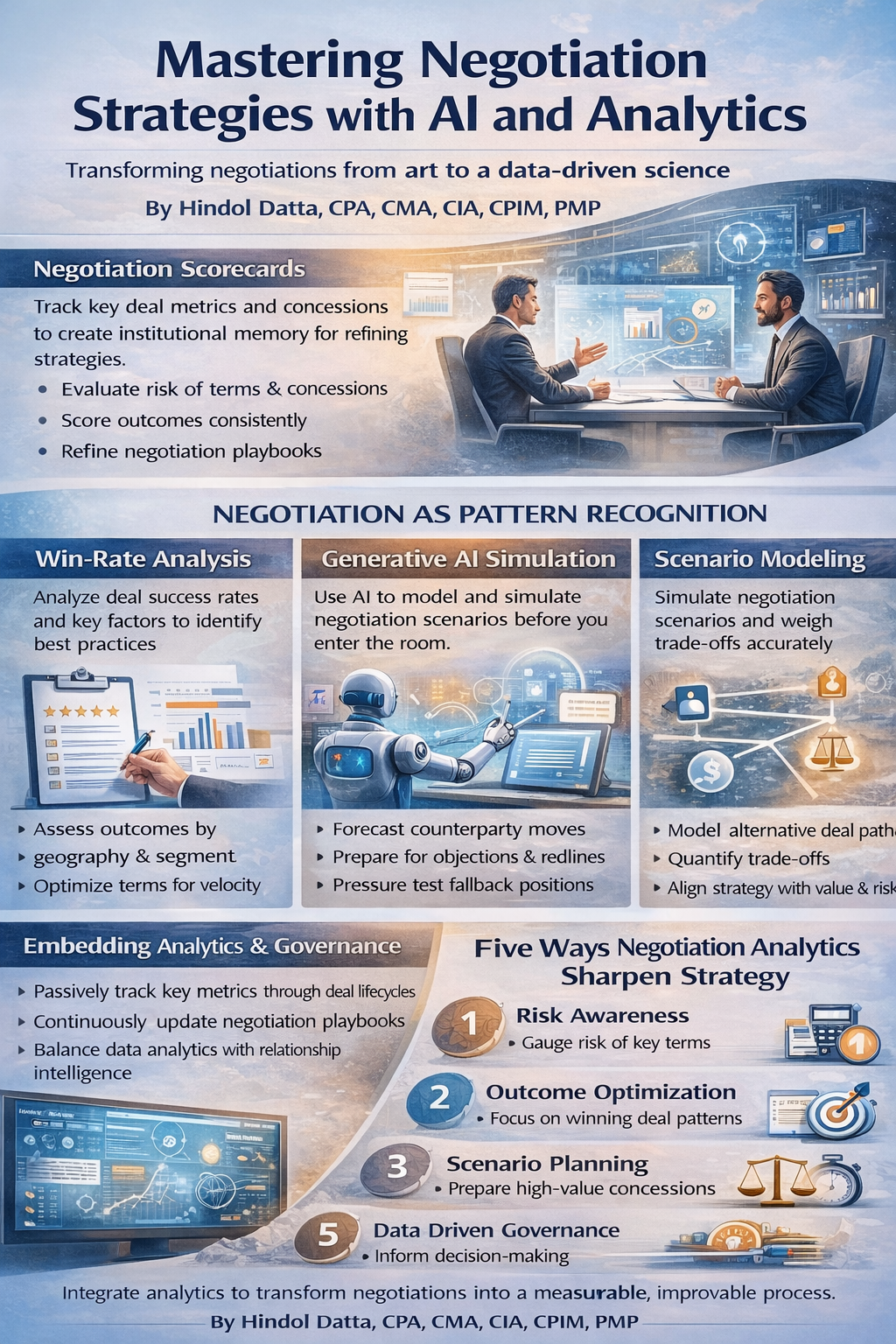
Enter the negotiation scorecard: a structured evaluation tool that tracks key elements of each deal, scores concessions made, and evaluates outcomes achieved. Unlike anecdotal feedback loops, a scorecard provides a consistent frame across negotiation types. Clauses can be rated for risk exposure, deviation from standard, or time to closure. Commercial terms can be assessed for alignment with strategy. And each deal, once completed, is codified into a dataset that refines future positioning. This is not bureaucracy. It is institutional memory in a quantitative wrapper.
My background as a Certified Internal Auditor informs this perspective. Just as we audit processes to identify control weaknesses and improvement opportunities, scorecards audit negotiations to identify patterns and optimization opportunities. Which terms do we concede too readily? Where do we hold firm successfully? What trade-offs create value? The scorecard transforms these questions from subjective debate into objective analysis.
During my time implementing business intelligence systems including MicroStrategy and Domo for tracking operational and financial metrics, I learned that consistent measurement drives improvement. When we could track deal cycle times, win rates by product line, average discount levels, and contract term distributions, we could identify outliers and optimize systematically. The same principle applies to negotiations. Measurement enables management.
Win-Rate Analysis: From Anecdote to Evidence
Win-rate analysis forms the second pillar of negotiation analytics. By analyzing the closure rates of contracts by geography, vertical, or sales archetype, organizations can identify what correlates with velocity and margin retention. For instance, deals in regulated industries may exhibit higher scrutiny on indemnity and limitation-of-liability clauses. If redlines in these areas correlate with longer cycles or lower conversion, teams can prioritize playbook creation or pre-negotiation briefings.
In one instance at a cybersecurity company, we found that simply pre-empting concerns about data breach indemnity with a fallback clause reduced closure time by eighteen percent over three quarters. The insight was not born of theory but of telemetry. We analyzed deal data, identified the pattern, created a standard response, trained the team, and measured the impact. This is negotiation analytics in practice: observation, hypothesis, intervention, measurement.
Having designed enterprise key performance indicator frameworks for tracking bookings, pipeline health, and customer metrics, I learned that what you measure shapes what you manage. When we tracked not just win rates but time-to-close, discount levels, payment terms, and contractual risk scores, we could optimize across multiple dimensions simultaneously. A deal that closes quickly but at heavy discount may not be better than one that takes longer but preserves margin. Win-rate analysis must be multidimensional.
Generative AI: Simulation Before Negotiation
Generative artificial intelligence has added a new vector to this discipline. Before entering high-stakes negotiations, I routinely use generative AI to simulate counterparty behavior, generate pros and cons of their redlines, and pressure test fallback arguments. This pre-meeting rehearsal is transformative. It helps replace narrative speculation with scenario precision. When opposing counsel argues for uncapped liability in data breaches, I have already modeled the impact on our risk profile, benchmarked it against industry norms, and understood the levers we could trade. The negotiation becomes less about surprise and more about calibrated response.
This application of artificial intelligence is distinct from the generative intelligence transforming other aspects of finance. Rather than generating forecasts or commentary, here AI generates negotiation scenarios and counterarguments. It serves as a sparring partner, allowing negotiators to pressure test their positions before entering the room. The technology is available today through large language models that can analyze contract language, identify typical negotiation points, and simulate responses.
My technical background including SQL and experience with various analytical platforms enables me to evaluate these tools critically. Not all AI-generated insights are equally valuable. The key is using AI to augment preparation, not replace judgment. The best negotiators combine data-driven preparation with relationship intelligence and situational awareness that no algorithm can replicate.
Scenario Modeling: Networks of Trade-Offs
Scenario modeling sits at the heart of this new negotiation paradigm. Rather than viewing each clause in isolation, scenario modeling evaluates the interdependencies: how changing one term affects the rest. What happens to cash flow if a payment term moves from thirty to sixty days? How does the risk-reward profile shift if we concede on warranty period but gain exclusivity? By simulating different deal paths, CFOs can guide negotiations with a decision-tree mindset rather than a clause-by-clause tug of war.
This is particularly valuable in multi-variable negotiations where multiple issues are in play and the temptation is to negotiate linearly. But real deals are not linear. They are networks of trade-offs. The time invested in scenario planning is more than compensated by the clarity it brings to the table. In one deal, we identified three paths to closure, each with different economic profiles. With scenario analytics, we were able to guide our sales team not toward the highest-revenue option but the one with the best risk-adjusted return.
Having built financial models and created scenario analyses for organizations raising over one hundred twenty million dollars in capital and executing over one hundred fifty million dollars in acquisitions, I learned that scenario thinking is foundational to strategic decision-making. The same discipline applies to negotiations. Model the alternatives. Quantify the trade-offs. Understand the sensitivities. Then negotiate with clarity about what matters and what does not.
Embedding Analytics Without Sacrificing Velocity
While the promise of negotiation analytics is compelling, its execution must be tempered with pragmatism. Commercial velocity remains paramount, and data collection must never become a tax on execution. The real skill lies in embedding analytics without ossifying agility. For deal desks managing dozens of deals across time zones and regulatory regimes, the question is not whether to apply data but how to do so without slowing the machine.
The first step is to build negotiation telemetry passively. Instead of asking teams to fill in forms post-deal, integrate metadata capture into the contract lifecycle itself. Modern contract lifecycle management platforms can tag clause types, track deviation levels, and capture time-to-signature data with minimal user input. By making data collection ambient rather than active, the organization builds its negotiation dataset without sacrificing flow.
My project management certification and experience leading implementations across multiple organizations taught me that adoption depends on minimizing friction. If data collection requires substantial manual effort, teams will not do it consistently. But if it happens automatically through systems they already use, data quality improves while user burden decreases. This is systems thinking applied to process design.
The second layer involves playbook evolution. Most organizations have some form of contract playbook, but few treat it as a living instrument. The playbook must evolve continuously based on deal analytics. If fallback clauses consistently close faster without material risk, they should be elevated. If certain redlines consistently escalate, they should trigger pre-negotiation alerts. Integrating win-loss insights into playbook reviews each quarter yields dramatic improvement in both negotiation posture and deal velocity.
Training and the Negotiation Cockpit
Training also plays a pivotal role. Sales and legal teams must be trained not just in negotiation tactics but in interpreting the analytics. A clause flagged as high-risk is not a veto but a signal. A win-rate deviation is not a flaw but a diagnostic. By embedding analytics into training programs, teams develop negotiation literacy. They begin to see patterns, anticipate objections, and make smarter trade-offs. The negotiation process shifts from firefighting to foresight.
Throughout my career building and developing finance teams across multiple organizations and sectors, I learned that capability building is as important as technology implementation. The most sophisticated tools are worthless if teams do not understand how to use them or trust their outputs. Training must be ongoing, experiential, and reinforced through practice.
A particularly powerful tool in this evolution is the negotiation cockpit: a dynamic dashboard that surfaces key metrics for each in-flight deal. It shows clause status, risk scores, counterparty redline behavior, and decision points. More advanced systems include artificial intelligence-generated suggestions and deviation benchmarking. When deployed correctly, this cockpit does not slow negotiations. It accelerates them by reducing noise and focusing attention. Having a cockpit view allows finance leaders to advise senior stakeholders with clarity: which issues are material, which are noise, and which paths are most viable.
Governance and Human Intelligence
Governance must accompany all this sophistication. Not all data is equal, and not every insight deserves equal weight. The CFO must lead a governance cadence that reviews analytics quality, model relevance, and feedback loops. Just as financial forecasts are calibrated quarterly, negotiation analytics must be stress-tested. The danger of false precision, treating noisy data as gospel, is real. But it can be mitigated with discipline and feedback.
My experience implementing Sarbanes-Oxley controls and managing internal audit functions taught me that governance frameworks must be appropriate to risk. High-stakes negotiations warrant intensive analytics and review. Routine renewals may require lighter oversight. The governance structure should match the materiality and complexity of what is being governed.
Crucially, this analytical sophistication must not come at the cost of relational intelligence. Deals are made by people, not spreadsheets. Data should inform tone, timing, and strategy, but it should not strip the negotiation of its human texture. The most effective negotiators combine analytical sharpness with emotional intelligence. They use data to frame, not dictate. They use scenarios to prepare, not preempt.
Having negotiated complex licensing agreements, managed vendor relationships across global operations, and led commercial discussions with customers ranging from startups to Fortune 500 enterprises, I learned that relationship matters as much as terms. A counterparty who feels respected and heard is more likely to close favorably than one who feels steamrolled by data. Analytics should make you more effective, not more mechanical.
Conclusion: From Art to Science
In the end, negotiation analytics is less about technology and more about institutional intelligence. It is the culmination of curiosity, discipline, and pattern recognition. For CFOs, it is an invitation to lead not just in cost control but in value creation. By embedding negotiation analytics into commercial rhythm, organizations can move from reactive bargaining to proactive value engineering. They do not merely close deals. They architect better ones.
This is not a theoretical ambition. It is a lived experience. For those of us who have balanced the need for speed against the obligation to protect the firm from poorly structured contracts, negotiation analytics is not a tool. It is a mindset. It acknowledges that risk and reward are not discovered in the boardroom but engineered at the negotiation table. And like any discipline worth mastering, it begins with the humility to measure what we do, so we can do it better.
What emerges from this evolution is a profound philosophical shift. Negotiation is no longer a black box activity guarded by the persuasive elite. It becomes a measurable, improvable business process. Data turns intuition into insight. Scorecards convert opinion into evidence. And artificial intelligence transforms speculation into simulation. The modern CFO is uniquely positioned to lead this shift, not by becoming the chief negotiator but by embedding negotiation analytics into the rhythm of commercial governance. The organizations that master this discipline will close deals faster, preserve margin more effectively, and build competitive advantage through superior commercial execution.
Disclaimer: This blog is intended for informational purposes only and does not constitute legal, tax, or accounting advice. You should consult your own tax advisor or counsel for advice tailored to your specific situation.
Hindol Datta is a seasoned finance executive with over 25 years of leadership experience across SaaS, cybersecurity, logistics, and digital marketing industries. He has served as CFO and VP of Finance in both public and private companies, leading $120M+ in fundraising and $150M+ in M&A transactions while driving predictive analytics and ERP transformations. Known for blending strategic foresight with operational discipline, he builds high-performing global finance organizations that enable scalable growth and data-driven decision-making.
AI-assisted insights, supplemented by 25 years of finance leadership experience.