
Executive Summary
In times of structural disruption, firms do not win by cutting costs. They win by reallocating capital faster, smarter, and with greater conviction. Over the past decade, enterprise-wide digital investment has shifted from a tactical information technology project to a strategic imperative. What began as process automation or e-commerce enablement has evolved into a systemic transformation of how firms operate, compete, and grow. Having led digital transformation initiatives including enterprise resource planning implementations, business intelligence architecture projects, and operational analytics deployments across organizations spanning from nine million to one hundred eighty million dollars in revenue, I have witnessed this evolution firsthand. Today, enterprise-wide digital investments are less about the adoption of technology and more about the redefinition of the business model itself. From cloud-native infrastructure to artificial intelligence-assisted operations, from digital twin simulations to predictive analytics across the value chain, these initiatives constitute a new type of capital deployment. Unlike traditional capital expenditures that depreciate linearly, digital investments compound in insight, speed, and scale. This article explores the strategic implications of digital investments when executed at the enterprise level: how they reshape value chains, organizational structure, competitive advantage, and the economics of scale and scope.
Digital Investments Shift the Firm’s Strategic Gravity
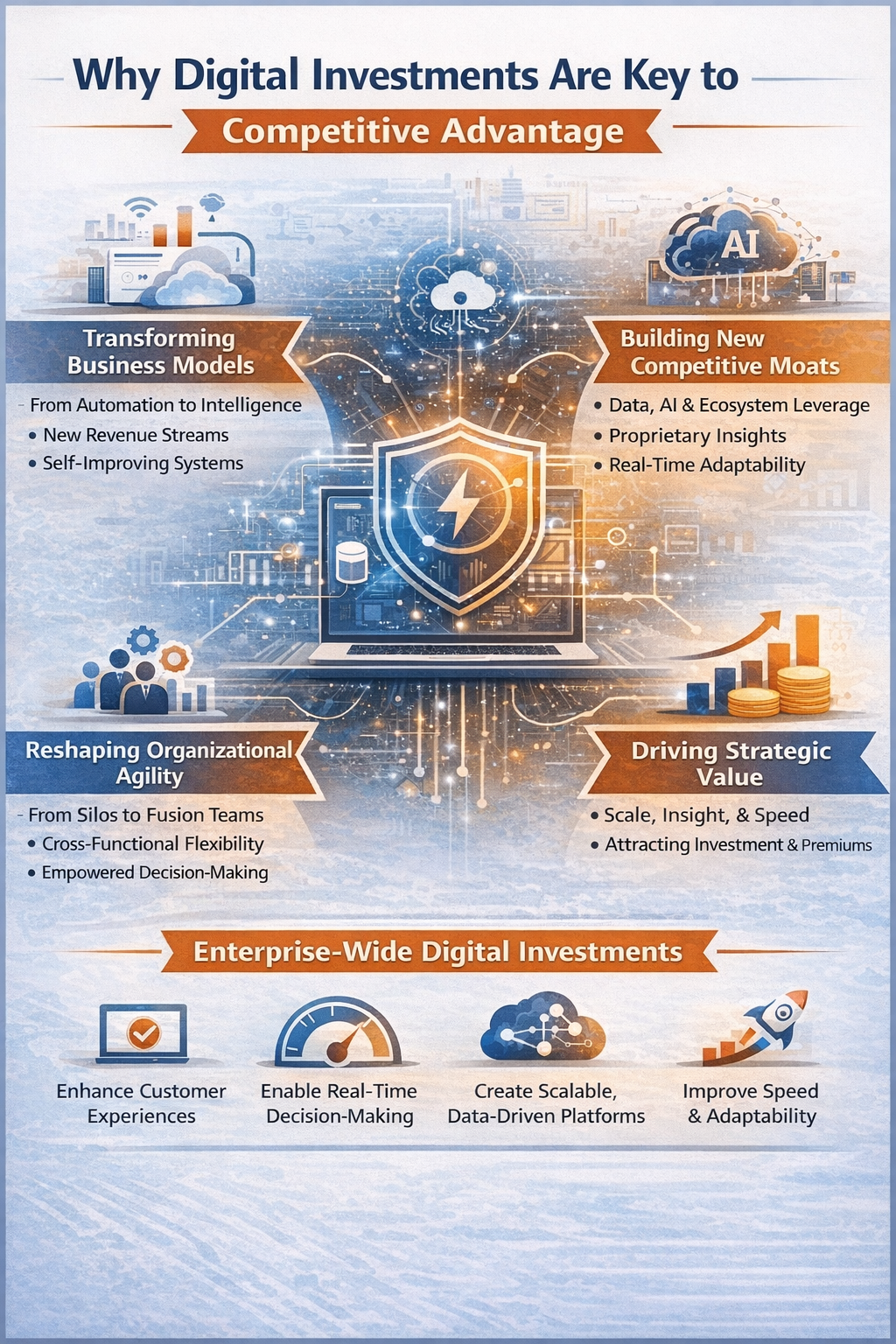
Traditionally, scale was a function of assets: plants, people, capital. In a digitized enterprise, scale becomes a function of intelligence: data, algorithms, and adaptability. When done right, digital investments create self-improving systems. A retail company with artificial intelligence-enabled supply chains reduces out-of-stock incidents while optimizing working capital. An insurer using machine learning for fraud detection identifies anomalies in real time, not months later. A logistics provider leveraging predictive maintenance extends asset life and reduces downtime by twenty to thirty percent.
During my time leading finance for a one hundred twenty million dollar logistics and wholesale enterprise, I witnessed how digital investments in supply chain analytics and warehouse management systems fundamentally changed our competitive positioning. We reduced logistics cost per unit by twenty-two percent not through traditional cost-cutting but by using data to optimize routing, consolidate shipments, and predict demand patterns. This was not efficiency improvement. It was strategic repositioning that allowed us to offer better service at lower cost than competitors still operating on legacy systems.
The core strategic implication is this: digital investments change what the firm is optimized to do. A company can shift from being product-led to customer-led, from efficiency-driven to insight-driven. That demands an overhaul not just of systems but of strategic posture. When I led the implementation of enterprise resource planning and professional services automation systems at a cybersecurity company, the initial goal was operational efficiency. The strategic outcome was the ability to track project profitability in real time, adjust resource allocation dynamically, and make data-driven decisions about which service offerings to expand and which to retire. The technology enabled a fundamentally different approach to portfolio management.
Capital Allocation and Portfolio Strategy Must Evolve
Digital transformation projects were once confined to departmental budgets. Today, they demand board-level capital allocation discipline. These are no longer line-item information technology expenses but enterprise-wide investments with enterprise-wide impact. For example, migrating to a unified cloud enterprise resource planning system might cost one hundred million dollars over five years, but the real return on investment stems from enabling faster mergers and acquisitions integration, real-time working capital visibility, and harmonized reporting. The payback is strategic optionality, not just cost savings.
The CFO’s role here becomes pivotal. Having managed capital budgeting and allocation decisions across multiple organizations, I learned that evaluating digital investments requires a different framework than traditional capital expenditure analysis. Capital budgeting must now include option value of digital platforms, such as the ability to plug in artificial intelligence or partner ecosystems. It must assess risk-adjusted returns across a portfolio of transformation bets, recognizing that some initiatives will deliver immediate returns while others create strategic capabilities that pay off over years. And it must account for digital depreciation schedules where relevance erodes faster than hardware.
When I led the financial planning for organizations raising over one hundred twenty million dollars in capital, investors increasingly asked not just about our financial metrics but about our technology stack, our data capabilities, and our digital roadmap. They understood that digital maturity was a leading indicator of future competitiveness. Strategic capital planning must move toward a model where digital investments are layered, staged, and continuously re-evaluated.
During my time implementing NetSuite, Oracle Financials, OpenAir professional services automation, and integrating them with Salesforce and business intelligence platforms, I learned that the most successful implementations were those where we treated technology as a portfolio of interconnected investments rather than discrete projects. Each system created data and capabilities that other systems could leverage. The value was in the ecosystem, not just the individual components.
Competitive Moats Become Digital and Dynamic
Historically, moats were built with physical barriers: distribution networks, regulatory licenses, sunk costs. In the digital era, moats are made of data, software, and ecosystems. But they are also perishable. Enterprise-wide digital investments can generate new defensible advantages. Proprietary customer insights from data lakes and artificial intelligence models create understanding of customer behavior that competitors cannot easily replicate. Superior operational response due to real-time analytics enables faster adaptation to market changes. Ecosystem leverage, enabling monetization via application programming interfaces and platforms, creates network effects that compound over time.
Yet because software is replicable and cloud-native tools are accessible to all, these moats must be renewed continuously. The implication is clear: digital advantage is less about what you own and more about how you evolve. Having designed enterprise key performance indicator frameworks using business intelligence tools like MicroStrategy and Domo for tracking bookings, utilization, backlog, annual recurring revenue, pipeline health, customer margin, and retention, I learned that the competitive advantage was not in the dashboards themselves but in the organizational capability to act on insights faster than competitors.
Boards and leadership teams must measure competitive health not only in terms of market share but also digital adaptability: how quickly the enterprise can sense, decide, and act on new information. When I led financial planning and analysis for a programmatic marketing platform, our competitive advantage was not superior algorithms but superior speed in deploying and optimizing campaigns based on real-time performance data. Competitors with better technology but slower decision cycles consistently underperformed us.
Organizational Design Must Match Digital Ambitions
Enterprise-wide digital investment often stumbles not due to bad technology but due to organizational mismatch. The logic of digital is speed, cross-functionality, and learning. The logic of many firms is hierarchy, silos, and control. To realize value from digital investments, firms must shift from project teams to product teams, treating digital channels as internal products with dedicated ownership. They must create fusion teams of domain experts, engineers, and data scientists who can translate business needs into technical solutions. And they must empower decision-making at the edge with data and tooling rather than requiring everything to escalate through hierarchical approval chains.
Critically, leadership must develop digital fluency. Chief information officers, CFOs, chief operating officers, and even chief human resources officers must speak a common digital language: one of application programming interfaces, latency, use cases, and user experience, not just compliance and governance. My background spanning certifications in accounting, management accounting, internal audit, production and inventory management, and project management reflects this multidisciplinary requirement. Modern finance leadership requires not just financial expertise but also technological literacy, operational understanding, and project execution capability.
Throughout my career building finance organizations across cybersecurity, software as a service, digital marketing, gaming, logistics, manufacturing, and education sectors, I learned that the most effective teams were those that combined deep functional expertise with technological fluency. Analysts who could write SQL queries. Controllers who understood system architecture. Planners who could design data models. This was not about everyone becoming an engineer. It was about everyone understanding enough to collaborate effectively with engineers and make informed decisions about technology investments.
Governance, Risk, and Change Management Need a Digital Upgrade
Digital transformation introduces both strategic upside and systemic risk. Artificial intelligence models may drift over time, producing less accurate results as underlying patterns change. Cloud integrations may leak data if security is not properly configured. Change fatigue may undermine adoption as employees struggle to keep pace with constant system updates. Cyber risk may metastasize across digital touchpoints, creating vulnerabilities that did not exist in legacy environments.
The board must establish digital key performance indicators distinct from traditional financial metrics. These include time-to-insight, measuring how quickly the organization can extract actionable intelligence from data. Model reusability, assessing whether artificial intelligence and analytics work can be leveraged across multiple use cases. Digital engagement scores, tracking how effectively employees and customers use digital tools. Traditional financial metrics remain important, but they lag. Digital metrics lead.
Clear accountability for digital value capture is essential. This means having product owners, not just project managers. Project managers deliver implementations on time and budget. Product owners ensure implementations create business value. Having managed Sarbanes-Oxley compliance, internal controls, and audit functions across multiple organizations, I learned that governance frameworks must adapt to digital speed. Annual control testing is insufficient when systems change monthly. Quarterly reviews of portfolio progress must replace annual strategic planning when market dynamics shift rapidly.
Risk management must be proactive, not reactive. It must focus not only on failures but on early signals of friction or value leakage. During my time implementing business intelligence systems and financial planning automation, I learned that the biggest risk was not system failure but slow adoption. If users did not embrace new tools, the investment would not deliver value regardless of technical success. Change management became as critical as project management.
Exit Multiples and Valuation Are Digitally Sensitive
The final strategic implication concerns the market itself. Increasingly, investors and acquirers reward digital maturity. Companies with robust digital infrastructure, scalable platforms, and advanced analytics capabilities often receive premium valuations. Research by Boston Consulting Group suggests that companies scoring high on digital maturity enjoy valuation premiums of ten to twenty percent relative to peers. More critically, digital maturity de-risks growth, improving forecast confidence, reducing customer churn, and enabling faster scale.
In mergers and acquisitions contexts, digital readiness has become a due diligence priority. Having overseen over one hundred fifty million dollars in acquisition transactions and led post-merger integration work including a one hundred million dollar acquisition for a multi-studio gaming enterprise, I witnessed this shift firsthand. Acquirers increasingly focus on technology stack, data architecture, system scalability, and digital capabilities during diligence. Legacy systems create integration risk and post-close costs. Modern, cloud-native architectures accelerate value realization and reduce integration friction.
Firms that invest proactively in digital infrastructure can exit at higher multiples, with greater buyer optionality and fewer post-deal surprises. When I led the design of multi-entity global finance architecture spanning the United States, India, and Nepal, one of the strategic benefits was creating a scalable, replicable model that could absorb growth or facilitate sale. Digital infrastructure became strategic infrastructure.
Similarly, when raising capital, digital maturity increasingly influences valuation. Investors understand that companies with sophisticated data capabilities, automated operations, and artificial intelligence-enabled decision-making can scale more efficiently than those relying on manual processes and legacy systems. During fundraising processes where I helped secure over one hundred twenty million dollars in capital across multiple organizations, investor questions increasingly focused on our technology stack, our data strategy, and our digital roadmap. They viewed digital maturity as predictive of future performance.
The CFO as Chief Architecture Officer
The implications for CFOs are profound. We must evolve from being guardians of historical financial performance to architects of future financial capability. This means leading digital investment decisions with the same rigor we apply to capital allocation. It means building finance organizations that are as digitally sophisticated as the businesses they support. And it means developing the multidisciplinary expertise to evaluate technology investments from strategic, financial, operational, and risk perspectives simultaneously.
Throughout my career implementing enterprise resource planning systems, business intelligence platforms, and operational analytics tools, I learned that successful digital investments share common characteristics. They have clear business sponsorship, not just information technology sponsorship. They are staged iteratively, delivering value incrementally rather than in big bang implementations. They include robust change management, recognizing that technology adoption is as much cultural as technical. And they are measured not just by implementation success but by business outcomes achieved.
My technical skills including SQL, R, Power BI, and various business intelligence and enterprise resource planning platforms are not just tactical capabilities. They enable strategic conversations with technology teams, informed evaluation of vendor proposals, and realistic assessment of implementation timelines and risks. Modern CFOs need not be engineers, but we must be fluent enough to participate meaningfully in architectural decisions that will shape our organizations for years to come.
Conclusion: Digital Investment as Strategic Doctrine
Enterprise-wide digital investment is no longer a side bet. It is the central doctrine of strategic relevance in a world defined by velocity, uncertainty, and intelligence. To treat it as a series of information technology upgrades is to miss the point. This is not digitization of existing processes. It is the re-architecture of the firm for the future.
Boards must evaluate digital decisions not merely through the lens of return on investment but through the broader calculus of optionality, resilience, and learning speed. The firms that do will not only operate better. They will out-adapt, outlast, and outgrow the competition. Having scaled organizations from nine million to one hundred eighty million dollars in revenue, led global operations spanning multiple continents, and managed through economic cycles and business disruptions, I can attest that digital capability increasingly separates winners from losers.
The digital revolution is not coming. It is already on the balance sheet. The question is whether your organization is investing strategically or reactively, whether you are building digital capabilities that compound over time or implementing point solutions that depreciate quickly. The CFOs who answer this question correctly, who lead their organizations to invest in digital infrastructure that creates strategic optionality and competitive moats, will deliver disproportionate value to their stakeholders. Those who view digital as a cost to be minimized rather than an investment to be optimized will find themselves managing increasingly obsolete organizations in an increasingly digital world.
The time for digital investment is now. The strategic imperative is clear. The tools are available. The question is whether finance leaders will step up to architect the digital future or remain managers of the analog past.
Disclaimer: This blog is intended for informational purposes only and does not constitute legal, tax, or accounting advice. You should consult your own tax advisor or counsel for advice tailored to your specific situation.
Hindol Datta is a seasoned finance executive with over 25 years of leadership experience across SaaS, cybersecurity, logistics, and digital marketing industries. He has served as CFO and VP of Finance in both public and private companies, leading $120M+ in fundraising and $150M+ in M&A transactions while driving predictive analytics and ERP transformations. Known for blending strategic foresight with operational discipline, he builds high-performing global finance organizations that enable scalable growth and data-driven decision-making.
AI-assisted insights, supplemented by 25 years of finance leadership experience.