
Executive Summary
The finance organization has long been defined by precision, structure, and control. Numbers were sacred, spreadsheets were battlefields, and reporting cycles ran on fixed calendars. The finance team served as the analytical anchor, measured and methodical in its approach. That model, while durable, is showing its age. Generative intelligence is entering the finance office, and it does not follow templates, wait for quarter-end, or care for manual reconciliations. GenAI is redefining the entire architecture of modern finance organizations. What was once a department of number crunchers will soon be a neural network of insights, models, decisions, and narratives. The CFO will not just oversee accounting, planning, and capital allocation but will become a neural architect, designing systems where algorithms and analysts work side by side, where insight is continuous, and where finance is as predictive as it is precise. Throughout my twenty-five years leading finance across cybersecurity, SaaS, manufacturing, logistics, and gaming, I have witnessed multiple waves of technological transformation. From implementing NetSuite and OpenAir PSA to building enterprise KPI frameworks using MicroStrategy, Domo, and Power BI, each advancement expanded what finance could achieve. GenAI represents not merely another tool but a fundamental restructuring of how finance organizations think, operate, and create value.
Finance as a Neural System
In the old world, finance was a hierarchy. There were teams for planning, reporting, compliance, and treasury. Each had a clear remit and operated on fixed cadences. Data moved slowly. Insight emerged through manual synthesis. Strategy was episodic. In the GenAI era, finance becomes a neural system where data flows continuously from transactional systems, external signals, and operational feeds. Models operate autonomously, surfacing risks, anomalies, and opportunities in real time. Assistants generate insights, draft commentary, and simulate outcomes at the speed of thought. Human experts review, contextualize, and direct, no longer crunching but curating.
Throughout my career, from reducing month-end close from 17 days to under six days at a cybersecurity firm to designing multi-entity global finance architecture spanning the United States, India, and Nepal, the constraint has always been the speed at which data could be transformed into insight. Manual consolidations, reconciliations, and variance analysis consumed the hours that should have been spent on strategic analysis. GenAI removes this constraint. It is less about reporting and more about cognition, less about hierarchy and more about intelligent signal routing. Finance becomes a living system, responsive, adaptive, and embedded into every business decision.
The Evolution of Finance Roles
GenAI will not automate the finance team out of existence. What it will do is dramatically reallocate the work. Transactional processing including invoice coding, journal entry drafting, and reconciliations becomes machine augmented. Variance analysis is generated with narratives, not just numbers. Board preparation becomes a conversation where you can draft three slides on quarterly margin variance with commentary from the last earnings call. Scenario modeling happens in minutes using natural language prompts rather than days of spreadsheet work.
What does this mean for the organization? Roles evolve. The planner becomes a model orchestrator. The controller becomes a data integrity steward. The analyst becomes a narrative strategist. And the CFO becomes the architect of a system designed to think, learn, and guide. When I led board reporting at companies including a gaming enterprise where I oversaw $100 million in acquisitions and post-merger integration, the bottleneck was always synthesis. We had the data. We lacked the capacity to rapidly model scenarios, test assumptions, and articulate implications. GenAI eliminates this bottleneck.
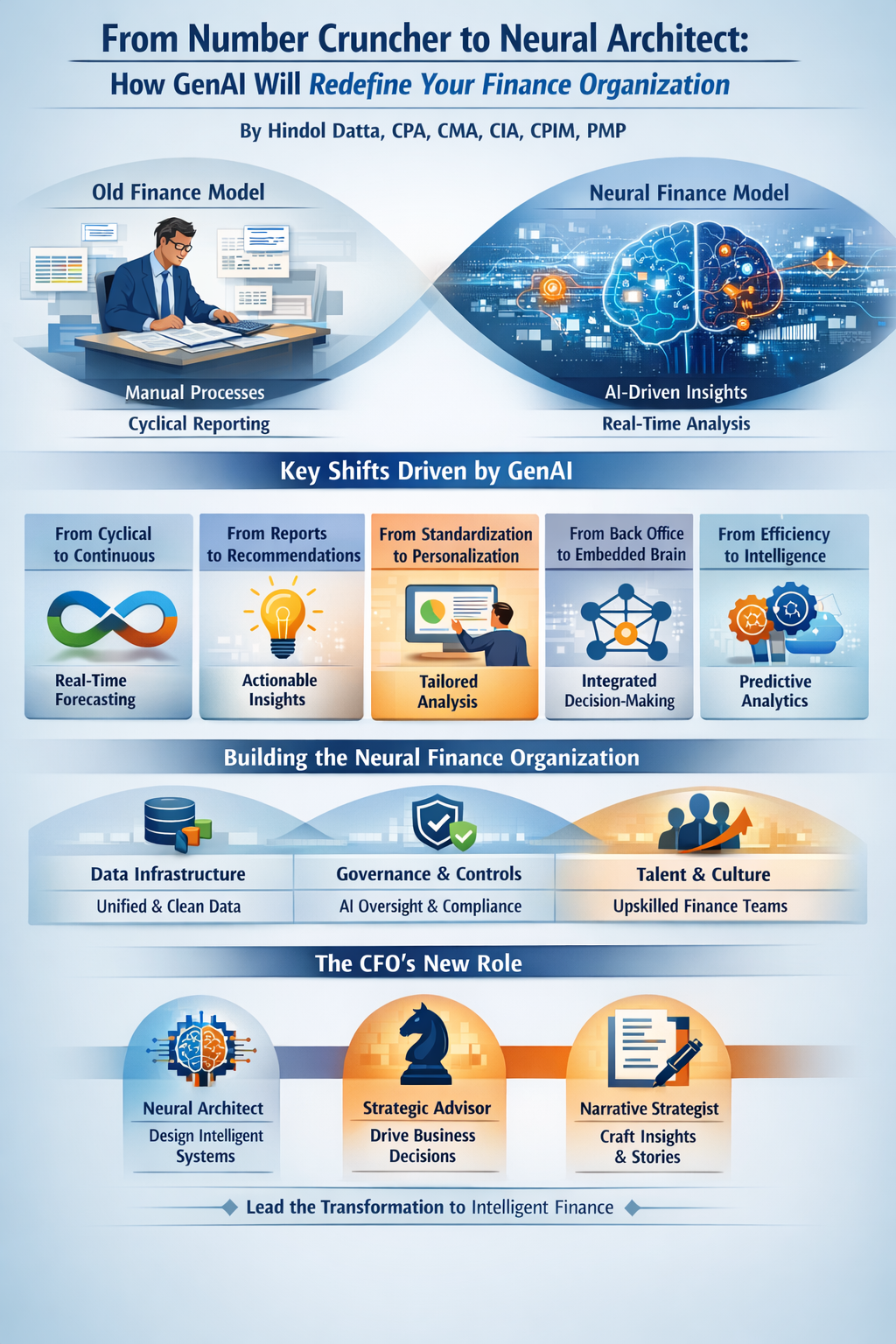
Five Structural Shifts
From Cyclical to Continuous
Planning and forecasting used to follow a rigid cadence, annual, quarterly, monthly. With GenAI, forecasts update continuously as new data arrives. The finance team becomes a real-time cockpit, monitoring shifts in key performance indicators, adjusting outlooks, and informing decisions dynamically. This demands a different operating rhythm including rolling collaboration, daily recalibration, and scenario conversations that never truly end. When I rebuilt GAAP and IFRS financials for a high-growth SaaS company and designed cohort analysis frameworks, we moved toward continuous monitoring of customer behavior and usage patterns. GenAI accelerates this transformation.
From Reports to Recommendations
In the past, finance delivered reports, packs of static numbers often divorced from action. GenAI enables a shift from outputs to outcomes. The system does not just show the number. It recommends what to do about it. Inventory days are rising. Consider adjusting procurement cadence for specific items based on historical lead times and demand forecasts. The finance team becomes a recommender system for the enterprise, not just a reporter. Throughout my work managing global finance and supply chain analytics for a $120 million logistics organization, I learned that insight without recommendation creates delay. GenAI closes this gap.
From Standardization to Personalization
Traditional finance tools offer standardized outputs including the same dashboards, reports, and commentary. But GenAI learns user context. It tailors insights for the plant manager, the CEO, the product lead. This personalization does not just improve experience. It improves adoption. When insights feel relevant, they are more likely to be used, and that is how finance scales its influence. When I built enterprise KPI frameworks tracking bookings, utilization, backlog, annual recurring revenue, pipeline health, customer margin, and retention, the challenge was making the same data meaningful to different audiences. GenAI solves this challenge at scale.
From Back Office to Embedded Brain
In the GenAI model, finance does not sit at the edge of decisions. It is embedded in every operational moment. Sales operations gets margin guidance mid-deal. Product teams get profitability scenarios on feature roadmaps. Human resources gets hiring plan forecasts that tie back to working capital health. Finance becomes a neural layer across the enterprise, connecting dots, surfacing signals, and shaping decisions in real time. At a digital marketing company where we scaled revenue from $9 million to $180 million, the turning point came when finance became embedded in go-to-market decisions rather than validating them after the fact. GenAI makes this embeddedness frictionless.
From Efficiency to Intelligence
Many finance transformations still fixate on efficiency including faster closes, fewer headcount, and more automation. But GenAI raises the bar. The goal is no longer just to run leaner. It is to run smarter. That means modeling uncertainty and not just tracking variance, generating insight and not just reporting history, and enabling judgment rather than merely executing processes. This is the shift from operational excellence to cognitive advantage. When I automated revenue recognition and project accounting using NetSuite and OpenAI PSA with 28 percent improvement in accuracy, the value was not just efficiency. It was the capacity to redirect human judgment to higher-value decisions.
Building the Neural Finance Organization
To build this next-generation architecture, CFOs must lead on three fronts. First is data infrastructure. GenAI thrives on clean, connected data. Finance must work with technology teams to ensure unified data models, consistent taxonomies, and accessible pipelines. This is not glamorous but it is foundational. Throughout my work implementing ERP systems including NetSuite, Oracle Financials, and Intacct, I learned that technology only delivers value when data architecture is sound. GenAI amplifies this principle.
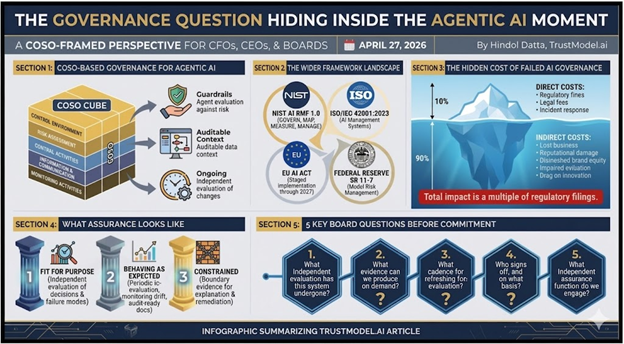
Second is governance and guardrails. With great power comes real risk. CFOs must define what AI can suggest and what still needs human approval, how models are validated, audited, and retrained, and what narratives can be auto-generated versus what requires review. Just as Sarbanes-Oxley built controls for reporting, GenAI needs a new framework of algorithmic accountability. My certifications as a CPA, CMA, and CIA reflect a commitment to controls and governance. GenAI does not eliminate this responsibility. It transforms it.
Third is talent and culture. This shift will not work without investment in talent. Finance teams need fluency in prompting AI for useful outputs, interpreting probabilistic results, curating narratives for business consumption, and questioning the machine when outputs seem off. This is not about hiring only data scientists. It is about upskilling finance professionals to be interpreters, not just executors. Throughout my career leading distributed teams across geographies and functions, the breakthrough moments came when teams shifted from executing processes to interpreting systems. GenAI accelerates this transition.
Closing Summary
The future of finance is not a bigger dashboard or a faster close. It is a more intelligent, connected, and adaptive system where generative intelligence works alongside human judgment to create value, manage risk, and inform every decision the enterprise makes. The CFO who sees this is not just automating. They are architecting a new kind of finance organization, one that thinks like a network, acts like a partner, and learns like a system.
Throughout my career, from standing up finance functions in emerging industries to leading global operations across multiple entities, from securing over $120 million in capital raises to implementing enterprise systems that transform how finance operates, the constant has been the need to adapt to technological change while preserving financial discipline. GenAI represents the most significant transformation yet. It does not replace the fundamentals of sound financial management. It amplifies them. The neural finance organization will still require precision, but that precision will be deployed toward insight rather than calculation. It will still require structure, but that structure will enable adaptation rather than rigidity. It will still require control, but that control will govern intelligence rather than merely transactions. The CFOs who thrive in this environment will be those who embrace their role as neural architects. They will design systems where human judgment and machine intelligence create capabilities neither could achieve alone. They will build organizations where finance is not a periodic function but a continuous presence in every strategic decision. They will create cultures where curiosity outpaces routine and where learning becomes the primary competitive advantage. This is not a distant future. It is the mandate of the present. The tools exist. The question is whether finance leaders will rise to architect the systems that unlock their potential.
Disclaimer: This blog is intended for informational purposes only and does not constitute legal, tax, or accounting advice. You should consult your own tax advisor or counsel for advice tailored to your specific situation.
Hindol Datta is a seasoned finance executive with over 25 years of leadership experience across SaaS, cybersecurity, logistics, and digital marketing industries. He has served as CFO and VP of Finance in both public and private companies, leading $120M+ in fundraising and $150M+ in M&A transactions while driving predictive analytics and ERP transformations. Known for blending strategic foresight with operational discipline, he builds high-performing global finance organizations that enable scalable growth and data-driven decision-making.
AI-assisted insights, supplemented by 25 years of finance leadership experience.