
Executive Summary
Finance leaders have historically kept fintech at arm’s length, treating banking as a legacy utility to plug into rather than rethink. But we are now in an era where the intersection of financial infrastructure and digital experience is being redefined by application programming interfaces, real-time payment rails, embedded finance, and platform-based services. This is not just banking as a service. It is banking as a platform. And any CFO not fluent in this shift risks making decisions with yesterday’s map. Having led treasury operations, cash management, and working capital optimization across organizations spanning from nine million to one hundred eighty million dollars in revenue, and having implemented enterprise resource planning systems and business intelligence architectures across sectors from software as a service to logistics to professional services, I have witnessed how fintech-savvy CFOs transform their organizations. They do not just manage money. They architect how money moves. They reimagine working capital as a dynamic, real-time system of value flow. They use fintech tools to compress invoice cycles, smooth treasury operations, optimize foreign exchange, and embed finance functions directly into customer and partner experiences. This article explores why banking as a platform represents a fundamental shift in how CFOs create value, and what finance leaders must do to become architects of their company’s commercial infrastructure rather than mere managers of traditional banking relationships.
The Old Model: Banking as Utility
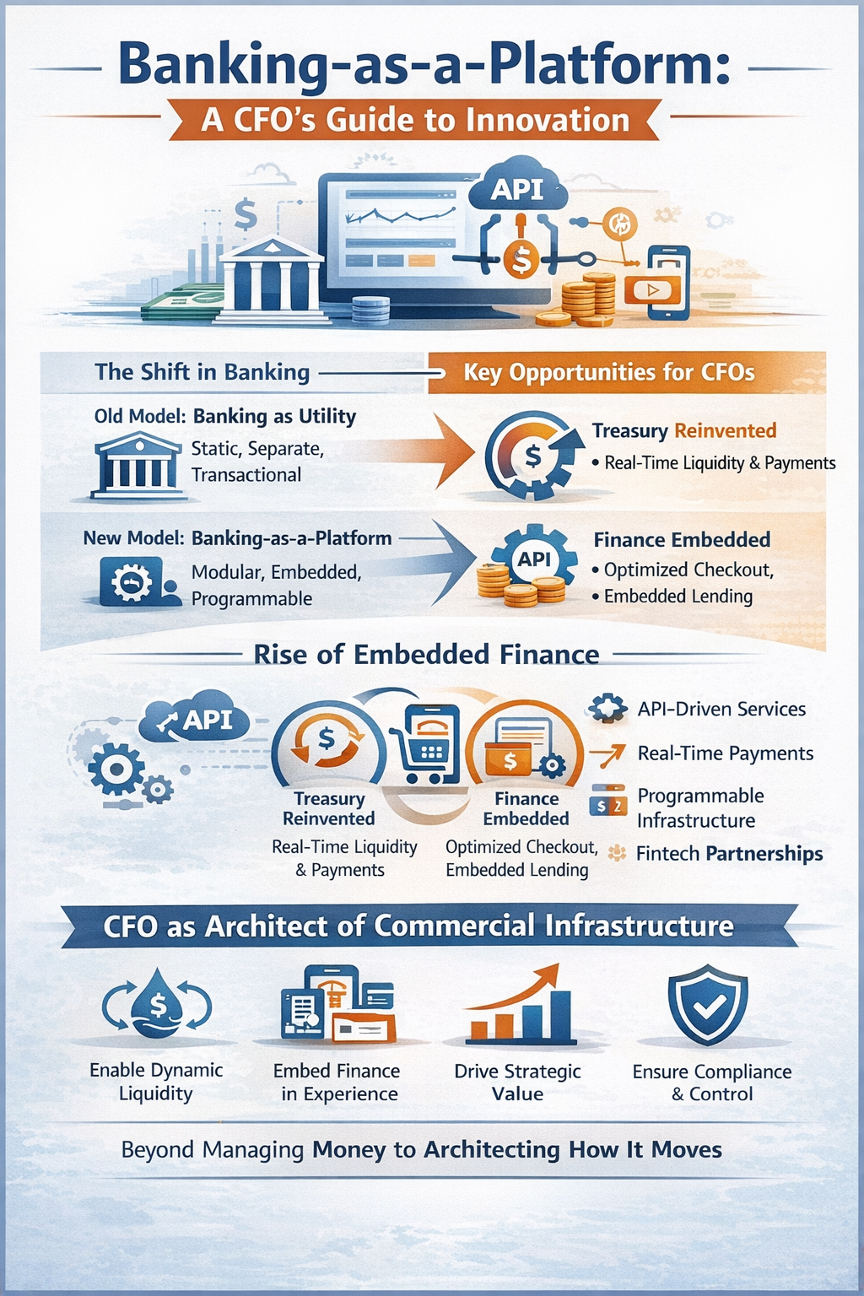
It is a curious thing how finance leaders, who serve as guardians of capital, custodians of liquidity, and interpreters of risk, have historically treated banking as a legacy utility. We automate the accounts payable cycle, we modernize enterprise resource planning systems, we deploy dashboards, and yet many CFOs still approach banking as something fixed and unchangeable. Traditionally, opening a corporate bank account, negotiating terms on a credit facility, setting up payroll, and moving on defined the relationship. All of this happened within the walled gardens of traditional financial institutions, with interfaces as user-friendly as tax forms and integrations that required patience or professional services. The relationship was transactional. You went to the bank, you got a product, you left.
Throughout my career implementing financial systems including NetSuite, Oracle Financials, Intacct, and integrating them with platforms like Salesforce and various payment processors, I experienced these limitations firsthand. The bank was separate from your operations. Integration was manual or required expensive middleware. Real-time visibility was a dream. And innovation happened on the bank’s timeline, not yours.
The Fintech Revolution: Banking Comes to You
But fintech has flipped that model entirely. Now, banking comes to you: modular, programmable, and on-demand. You do not have to accept a bundled treasury service from a Tier 1 bank. You can pick best-in-class application programming interfaces for payments, for virtual accounts, for real-time reconciliation. You can offer debit cards to your users. You can embed lending into your checkout flow. You can issue invoices that reconcile themselves. The bank is no longer the cathedral. It is the codebase. And the CFO who understands this becomes more than a finance lead. They become an architect of the company’s commercial infrastructure.
This shift is not about buzzwords. It is about leverage. Because fintech-savvy CFOs do not just manage money. They architect how money moves. They reimagine working capital not as a balance sheet line item, but as a dynamic, real-time system of value flow. Having managed working capital optimization and treasury operations for organizations including a one hundred twenty million dollar logistics and wholesale enterprise, I learned that the traditional tools provided limited visibility and even less agility. The fintech revolution changes that fundamentally.
Transforming Core Treasury Operations
The benefits are profound. Take liquidity management as an example. Traditionally, managing liquidity meant projecting cash flow, reconciling across banks, and ensuring buffers. It was reactive and time-consuming. When I led treasury operations and secured credit facilities including an eight million dollar credit line for a nonprofit organization, the process involved manual cash flow forecasting, periodic reconciliation, and substantial operational overhead. But fintech tools now let CFOs see cash positions across entities and currencies in real time. Treasury operations, once reactive, can become proactive. Short-term investments can be automated based on predefined parameters. Foreign exchange exposure can be hedged programmatically using algorithmic tools. Working capital can be turned into strategic leverage, not just operational necessity.
This transformation extends to receivables and payables. Accounts receivable used to be a back-office function managed through periodic invoicing and manual follow-up. Now, with embedded payment links, dynamic invoicing, and real-time alerts, collections can be optimized and customer friction minimized. On the payables side, programmable payment platforms allow CFOs to control timing, approval layers, and vendor visibility all in one interface. Spend control becomes real-time, not post-mortem. And auditability improves by default because every transaction is logged, categorized, and traceable through the system.
During my time automating revenue recognition and implementing ASC 606 compliant processes across professional services and software as a service businesses, I saw how manual invoicing and collection processes created delays and errors. Fintech tools eliminate these friction points entirely. The invoice is generated automatically based on contract terms, the payment link is embedded and branded, and reconciliation happens instantly when payment is received. What once took days of analyst time now happens automatically.
Embedding Finance into Product Experience
Beyond operational efficiency, fintech-savvy CFOs are transforming customer experience in ways that directly impact revenue and retention. Consider a platform with marketplace sellers or gig economy workers. In the old world, payouts might be processed weekly, with delays due to traditional bank rails. In the new world, you can embed real-time payouts. That improves user retention and loyalty measurably. Users who can access their earnings immediately value the platform more highly and are less likely to churn.
Or consider offering financing at checkout. Rather than sending customers to third-party providers, you can integrate embedded lending directly in your product, branded as yours, funded by a fintech partner, and yielding margin upside with minimal risk. This is what it means to build finance into the product, not just around it. It represents the shift from back office to front line, from processor to enabler. And at the center of it is the CFO, rethinking not just cost but experience, not just control but opportunity.
Having led revenue operations and deal desk functions for a cybersecurity and professional services company, I saw how payment terms and financing options directly influenced deal velocity and customer acquisition. Traditional banking relationships could not support the flexibility we needed. But with fintech platforms, we could offer customized payment terms, installment options, and dynamic pricing that adapted to customer needs. This was not just a finance improvement. It was a competitive advantage.
The CFO as Orchestrator and Risk Manager
But of course, opportunity must be matched with control. And here is where the modern CFO adds value that no other function can. Fintech tools are powerful, but they fragment quickly. Application programming interfaces abound. Dashboards proliferate. Risk gets obfuscated. The CFO brings coherence. They vet vendors not just on price but on security, scalability, and strategic alignment. They design approval frameworks. They ensure compliance with evolving regulations, from Payment Services Directive 2 to Service Organization Control 2. They integrate fintech systems into core enterprise resource planning and business intelligence infrastructure so that decision-making remains unified.
My background includes certifications in internal audit and management accounting precisely because finance leadership requires this control-oriented perspective. When evaluating fintech vendors, I assess not just functionality but controls. How is data protected? What is the disaster recovery plan? How are transactions audited? What segregation of duties exists? These are not information technology questions. They are finance questions. And the CFO must answer them before committing to any platform.
In fact, one of the most underappreciated roles of a fintech-savvy CFO is as orchestrator. In many growth companies, engineering is excited about new tools, operations is buried in the weeds, and compliance is late to the game. The CFO steps in and connects the dots. They ensure that payment application programming interfaces sync with cash flow planning. That revenue recognition aligns with billing systems. That fraud controls are in place. That partner contracts reflect the financial architecture.
Having led the implementation of business intelligence systems including MicroStrategy, Domo, and Power BI across multiple organizations, I learned that integration is where value gets created or lost. A payment platform that does not feed data into your forecasting model is just another silo. A billing system that does not integrate with your general ledger creates reconciliation nightmares. The CFO must design the architecture holistically, ensuring all components work together seamlessly.
Speaking the Language of Capital
And critically, the CFO speaks the language of capital. They understand the time value of money, the impact of velocity, the structure of covenants. They can translate the value of faster collections, reduced float, or better interchange economics into board-level return on investment. They can justify investment in fintech tools not as technology spend, but as financial optimization. When I managed board reporting for organizations across sectors from gaming to education to logistics, I learned that boards care about outcomes, not tools. They want to understand how a fintech investment improves days sales outstanding, reduces working capital requirements, or enhances customer lifetime value. The CFO translates technical capabilities into financial metrics that boards can evaluate.
This capability becomes even more strategic in capital raising. Investors increasingly expect finance leaders to have command over the financial stack. They ask about burn multiple, but they also ask about accounts receivable days. They care about customer acquisition cost, but they also want to know how you manage treasury. Having led fundraising processes that secured over one hundred twenty million dollars in capital across multiple organizations, I can attest that investors evaluate operational maturity through the finance function. A CFO who can explain the full financial system, from embedded finance to instant reconciliation to platform partnerships, signals operational sophistication. And operational sophistication lowers perceived risk, which increases valuation.
Preparing for What Comes Next
Fintech fluency also prepares CFOs for what comes next. Open banking is gaining traction, requiring application programming interface access to customer banking data with consent. Blockchain is introducing programmable settlement that could transform how B2B payments work. Stablecoins are emerging as potential rails for cross-border transactions. The regulatory landscape is adapting, slowly but surely. And the finance leader who can track these shifts, not from hype but from fundamentals, will steer their company with clarity while others play catch-up.
Of course, not every CFO needs to code in Python or write structured query language queries directly to a ledger. But every modern CFO must understand the implications of programmable money, composable finance, and embedded infrastructure. They must see banking not as a static service, but as a dynamic layer. And they must build teams that can execute on that vision: finance engineers who understand both accounting and application programming interfaces, payment operations specialists who can manage vendor relationships and reconciliation, revenue architects who can design billing systems that scale.
Throughout my career working with technologies including SQL, R, and various business intelligence platforms, I have maintained that CFOs do not need to be engineers. But we must be fluent enough to have informed conversations, make sound architectural decisions, and evaluate trade-offs. We must understand what is possible, what is practical, and what is premature. This technical fluency, combined with financial rigor, is what separates modern CFOs from those still treating banking as a utility.
The Reality: It Is Already Happening
This is not theoretical. It is already happening across industries. Software as a service companies are embedding billing logic that flexes by usage, creating pricing models that were impossible with traditional invoicing. Marketplaces are monetizing float through banking partnerships, earning yield on funds that temporarily sit in their systems. Logistics companies are optimizing fuel payments through card programs that provide data on spending patterns and negotiating leverage with suppliers. In each case, the CFO is not waiting for the bank to tell them what is possible. They are telling the bank what they need. And increasingly, they are doing it without the bank.
Having scaled organizations from nine million to one hundred eighty million dollars in revenue, I saw firsthand how payment infrastructure either enables or constrains growth. When payment processing is slow, clunky, or expensive, it creates customer friction and operational drag. When it is fast, seamless, and economical, it becomes invisible infrastructure that just works. The difference is not incremental. It is transformational.
Banking as a platform is not about replacing banks. It is about abstracting them, choosing best-of-breed components and building a stack that matches the company’s strategy. It is about turning the financial nervous system into a source of speed, data, and resilience. And it is the CFO who must lead that design.
Conclusion
Because in the end, every company is a financial company. Money moves. Margins matter. Timing is everything. And in a digital economy, those truths are governed not just by accountants, but by architects. The CFO is no longer the keeper of the ledger. They are the builder of the system. And that system now runs on code.
The shift from banking as utility to banking as platform represents one of the most significant changes in finance leadership in decades. It requires CFOs to expand their skill sets, rethink their relationships with financial institutions, and redesign their organizations around programmable infrastructure. Those who embrace this shift will create competitive advantages through faster operations, better customer experiences, and more intelligent capital management. Those who resist will find themselves managing increasingly obsolete processes while competitors move at digital speed.
The choice is clear. The tools are available. The question is whether finance leaders will step up to architect the future or remain managers of the past. Based on my experience across industries and stages, I can tell you that the CFOs who choose to become architects will find this work among the most impactful of their careers. Banking as a platform is not just a technology shift. It is a strategic opportunity to fundamentally reshape how your organization creates and captures value. The time to act is now.
Disclaimer: This blog is intended for informational purposes only and does not constitute legal, tax, or accounting advice. You should consult your own tax advisor or counsel for advice tailored to your specific situation.
Hindol Datta is a seasoned finance executive with over 25 years of leadership experience across SaaS, cybersecurity, logistics, and digital marketing industries. He has served as CFO and VP of Finance in both public and private companies, leading $120M+ in fundraising and $150M+ in M&A transactions while driving predictive analytics and ERP transformations. Known for blending strategic foresight with operational discipline, he builds high-performing global finance organizations that enable scalable growth and data-driven decision-making.
AI-assisted insights, supplemented by 25 years of finance leadership experience.